Author Archives: Jane Cawthorne

About Jane Cawthorne

Jane is a writer currently living in Victoria BC. She grew up in Toronto and also spent many years in Calgary where, among other things, she taught Women's Studies at Mount Royal College (now Mount Royal University). Her work is about women on the brink of transformation.

Book Recommendations for Mother’s Day

This morning, I happened upon a tweet by Jael Richardson who expressed that she’s not too keen on what she’s seeing on book recommendations for Mother’s Day. I responded, interested in what she would recommend.

Richardson’s point is that she wouldn’t make a different recommendation to mothers than she would for anyone else. She writes, “My favourite books for ‘mothers’ are my favourite books for people.” Yep, true. She objects to the spring time covers and so on, and is asking people to think about what the marketers think a “Mother’s Day book” is. It’s a good and important point to make.
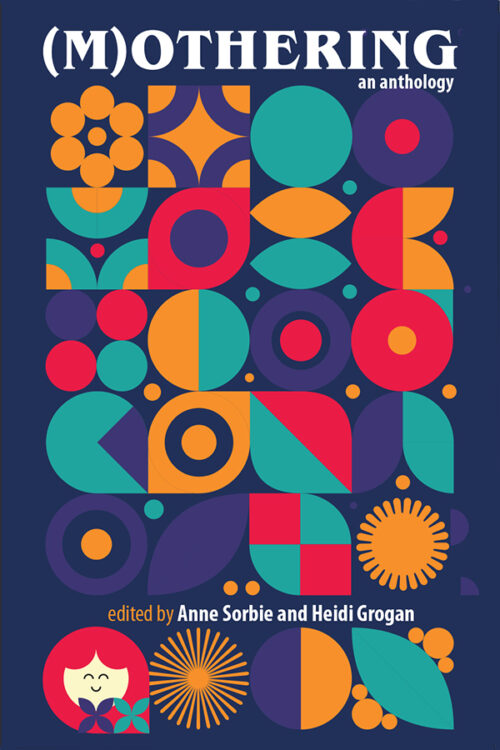
Cover of (M)Othering, a new anthology edited by Anne Sorbie and Heidi Grogan

Some of the other tweeters on the thread point out that Mother’s Day recommendations can be triggering, and this is so true for people who struggle with infertility or who have lost a child or children or have experienced any of the myriad things that can happen. Anne Sorbie, editor of the upcoming (M)othering Anthology with Inanna in Spring 2022 (with Heidi Grogan) has as inclusive an approach to mothering as I do and says in her tweet, “All people are and do (m)other” to capture that inclusivity. I had recommended her upcoming book in my reply because, well, I’m in it, and I think it’s a logical Mother’s Day book recommendation. I am certain it will be inclusive and wonderful.

The flip side of Richardson’s point is that books about mothers are good for people.

I can’t help thinking that sometimes readers are looking for books that reflect their reality. Sometimes, it is helpful, (and not to be too dramatic) even life-saving, to find someone else who captures something of your experience with their words. A colleague of mine, Diana Gustafson, edited a book called “Unbecoming Mothers: The Social Production of Maternal Absence,” which was groundbreaking and, if it weren’t so darned hard to find now, would be a great Mother’s Day recommendation. It’s about the stigmatization of mothers who come to live apart from their children, for whatever reason. Mothers who give up, surrender, or abandon their children are among the most stigmatized.

What we do to mothers. (Shakes head.)

So, while the recommended books for Mother’s Day may be problematic, it is part of a bigger problem: Mother’s Day itself is problematic. It’s not literally a Hallmark Holiday, but it might as well be. It’s easy to create a situation in which people feel excluded and judged. It becomes the opposite of celebratory. Most problematic of all is the way our culture thinks about mothers, limits them, expects too much of them and offers very little by way of support. Even the notion that mothers are women is, thankfully, being deconstructed as we challenge gender constructs and stereotypes. All of this is welcome.

I also can’t help thinking that marketers are gonna market. Any opportunity to recommend books will be seized. Let’s try and be thoughtful about it.

On Languishing in the Pandemic

Month 13–or is it 14?–of the pandemic, and I am languishing. I did not have that particular word in mind until I read an article about languishing by Adam Grant in the NYT. I had been thinking maybe it was ennui, or maybe disinterest, and was sometimes even wondering if I had become hopelessly lazy.

That’s not it.

I told my husband I was unmotivated, which is true. Confessed it, actually. I am NOT normally an unmotivated person. In his article, Adam Grant says something about being indifferent to indifference and that feels right. I am indifferent to my indifference, disinterested in my disinterest. Maybe you feel the same.

I know I’m lucky. I can work from home and shelter where I am, relatively safe. I get groceries delivered. I am grateful to all of the workers who are keeping us all going and I advocate for their safety literally every day.

Part of it is certainly that while the world celebrates the arrival of vaccines (as do I), Ontario is worse off than ever because of a feckless provincial government. We have higher case numbers than ever and our ICUs are overflowing. Refrigerator morgue trucks are next. It didn’t have to be this way.

So, I try to focus on what I can control. I have a new project on the go. But I am not writing much now. My concentration is poor. It’s also my fifth crashiversary this week, which doesn’t help. Five years of brain injury. My lack of concentration isn’t just about the pandemic. I have been in some state of languishing for a while.

And even if my writing is stalled, there is other work to do. As two projects make their way through to publication, they need bits of my attention. I will get a galley to proof next week. There are questions about marketing. A plan must be made.

I have other projects I could pick up outside of work, things I would usually enjoy. I have wool enough to make six hats which I planned on giving as gifts next Christmas. I need to sew the collar on a summer shirt I am making (polka dots!) and then it will be done. Maybe ten minutes of work. It is sitting beside the sewing machine. Languishing. I could make an interesting dinner. Or I could just scramble a few eggs. I could go for a walk. There are people in my life to care for. Some of them are also languishing and how can I support them when I am too? A birthday cake must be baked. Doing things for others is usually something that cheers me up. The ingredients are all on my kitchen counter, waiting. My seedlings need replanting. The tomatoes are growing well, if a little spindly. Some of them are just lying down, like I want to. I have to stake them up with bamboo skewers.

Meh.

I need a bamboo skewer for me. What will that be? Sometimes, admitting you have a problem is the first step.

This is a “fake it till you make it” time if there ever was one. Time to fake some enthusiasm. Fake a sense of flourishing. As my character Alden often says to herself in Patterson House, “Buck up.” Wish me luck. I wish you luck too. We can do it.

Rosie the Riveter
Rosie the Riveter saying “We Can Do It”

Maybe I’ll have a nap first.

On Being Studied

It’s an incredible feeling when one of your dreams, something you had barely articulated even to yourself, becomes real. The work that I do with E. D. Morin (Elaine) is being studied. By academics. By scientists. Because women’s stories are an important source of knowledge.

I used to work in academia. I studied, took graduate degrees (though never a PhD) and taught Women’s Studies as a sessional at the college/university level. My discipline was marginalized, as were so many emerging disciplines like Indigenous Studies or Post Colonial Studies. (Thank goodness much as changed.) 

In the academy, claims must be supported. That’s a good thing. In hard science, that happens with experimentation that is repeatable and verifiable. In social sciences, it often means finding precedent for what you want to say and finding others (usually more established thinkers) who agree with you. But in a system that is enmeshed with patriarchy and colonialism, it was difficult to find corroboration for what, to me, seemed self-evident. At the time, academia was very much a system that had no interest in furthering the kind of thinking I liked to explore. 

Finally, I decided that there are lots of ways to know. One is through art. I set my sights on writing fiction, creative non-fiction, and personal essays to say the things I felt were true. 

Now the work Elaine and I have done together with so many contributing writers, is being studied. By academics. By social scientists. By medical science. It’s pretty great. 

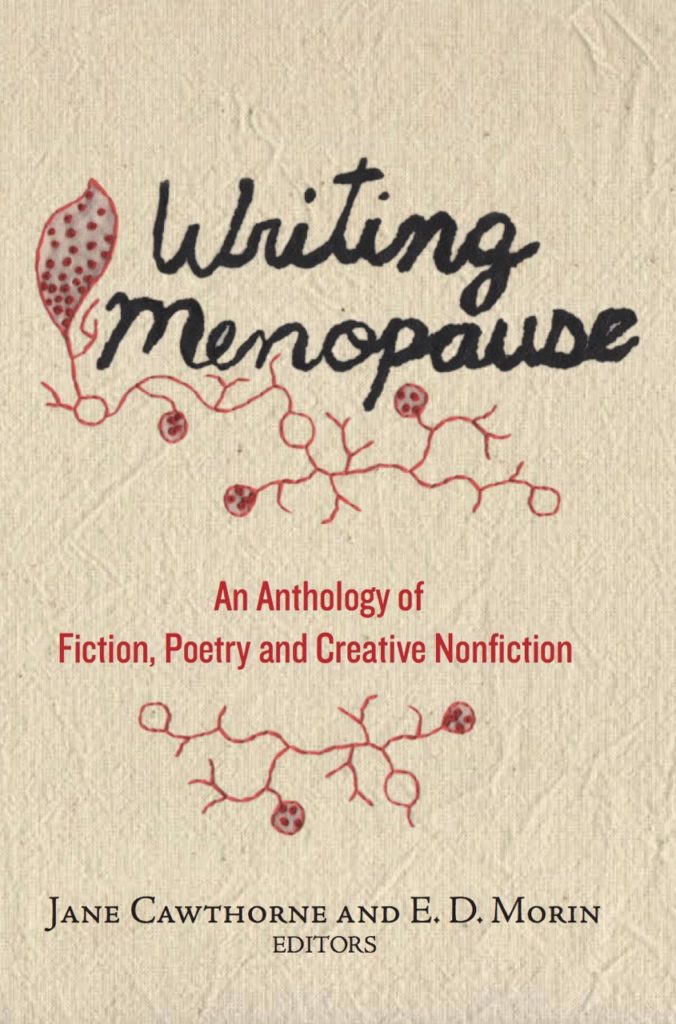
Cover Imagine of Writing Menopause
Cover Image of Writing Menopause

Elaine recently spotted Writing Menopause in a paper by Dr. Veronica Schuchter called, “The future is menopausal’: Un/Learning with Feminist Menopause Imageries in Canadian Writing.” She says lovely things about Writing Menopause in an academic way. She says the work serves to “destabilise discourses informed by biological essentialism around the normative female body and post-reproductive age.” Then she goes on to say that using our work and the work of others, she “explores how the creative realm is a crucial element in the process of un/learning and thinking beyond sexist, racist, and ageist perceptions of those experiencing menopause and instead presents ethical and inclusive ways to write about late middle-age.”

How much do I love this? More than you can imagine. When I was an academic, un/learning and thinking beyond sexist, racist, and ageist perceptions was my goal. It still is.

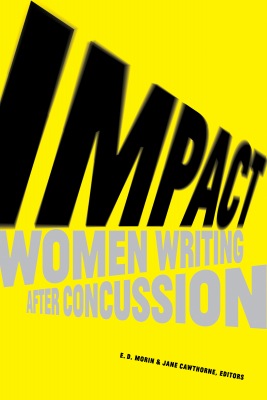
Cover Image of Impact: Women Writing After Concussion

Our next book, “Impact: Women Writing After Concussion” is already the subject of a research project at St. Michael’s Hospital Head Injury Clinic. Delayed last year because of the pandemic and a shift in resources towards Covid-19, we just learned that the study is on again. We are, of course, delighted that the work may influence the way women with concussion and traumatic brain injury are treated.

That’s the dream. I feel such gratitude to Elaine, the best colleague ever, and to every writer who contributed to these books. It’s been great to collaborate with all of these writers. I’m not an academic anymore, but I’m still kind of part of it, and in a way that is much more authentic for me.


Begin Again

In my meditation today, I was reminded that when my mind wanders, I can begin again. Focus on the breath. Begin again.

We can always begin again. 

Today is a good day to think about that.

What could we do?

It starts with story. We must know our own story.

We must tell the truth about what happened to us.

We could understand that we are all in this together, that the success of one is the success of all, and not just for humans.

We could devote ourselves to an ethics of care and compassion, to kindness to self and others, knowing that others are connected to us, and we to them, in profound ways. 

We could be humble and acknowledge what we have broken and our own brokenness. We could grieve for what we have lost, because we know that we have lost so much. We are not even sure what it is. But we know. We feel it. It exists as a hollowness in our soul that no amount of food or alcohol or consumer goods or anything else can fill.

We could help each other through the grief.

We could repair what is broken. We could make it our work.

We are ALL in this together: the humans, the trees, the plants, the insects, the air, the animals, the soil, the water, and even the rocks. Even the rocks.

We could build an economy that knows that the earth is not merely a resource for humans to use (up), but a part of us as we are a part of it. The earth’s health is our health. It gives and gives and we, the humans, must stop taking so much.

We could remove the barriers to sharing what we do take.  

We  could build an economy that acknowledges limits. 

It could be beautiful.

Think of what you would begin again, if you could, and know that you can. 

Winter Solstice 2020

These are dark days. The shortest day of the pandemic feels like the longest.


My sister came over to drop off gifts on the porch and she could not stop crying. She was crying when she arrived, cried through her five minute stop and was crying when she left. My daughter visited on a layover as she travelled across the country to do her shift at the mine. We went for a walk in the damp and cold, stayed outside until we were too cold to be outside anymore, and then she was off again to continue her journey to her work site. Instead of lamenting that I could not hug either of them, or even get close to them, or see their faces through their masks, I tried hard to be grateful I got to see them at all. And I am. But at the end of the day, I cried too. 

This pandemic. It’s hard. It’s a good time for crying. The tears keep coming. 

Gratitude in 2020

Gratitude? In 2020? This year of disruption and staggering losses? Yes.

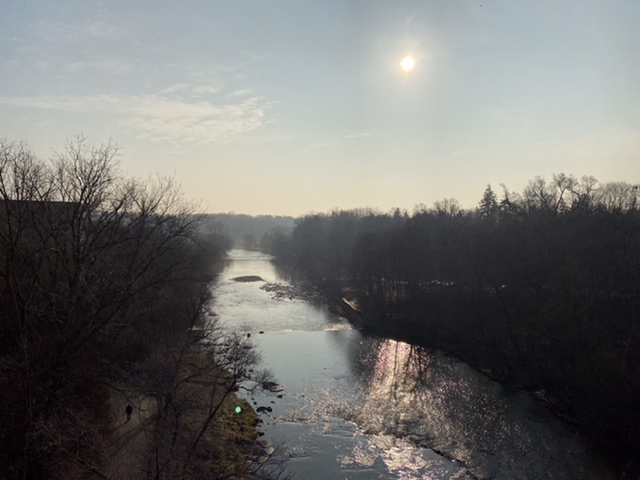
The Humber River, Toronto, a view from one of my regular walks that inspires gratitude.

I’m grateful:

1. For Clarity. My vision is 20/20. I know what matters. People. Community. Love. And the earth which supports it all. And I know what doesn’t matter. Whether my hair is cut. Things. Productivity and other cudgels of capitalism. Just as I was wondering if humanity is doomed, I got to witness how we can change our collective priorities quickly.

2. For People. I am grateful for family, thick and thin friends, the kindness of strangers, neighbours, delivery people, doctors, nurses, teachers…everyone. I am grateful for the enthusiasms of my community and the skills and talents they have shared throughout the year.

3. For Slowness. I have a brain injury, and I have required a slower pace since 2016. In the before-time, I fought this need. I thought it was something I had to change. I thought that regaining my old pace was a goal and would be a mark of my recovery. Not anymore. I have learned to embrace my slow pace. It’s a relief. In part, I have been able to do this because everyone else had to slow down too.

4. For Solitude. I miss my people. (See 2.) But. (See 3.) I can do things AND be alone. While others complain about life on Zoom, for me (and many other people with disabilities) Zoom means accessibility. I can participate while not having to negotiate so many other things. I can lower the volume, focus on a single speaker, dim the brightness. Sure, real life is better. But having something is better than nothing, and I am grateful for everything I have been able to participate in because of Zoom. I can only hope that when this is over, the avenues of access that have opened so the able-bodied and neurotypical can carry on will remain open for the rest of us. Will every literary festival make on-line access possible? Will readings still be on line? Will I be able to listen to a concert on line or see a show? I hope so.

5. For Breath. Breath is life. The virus makes breathing a struggle and even takes it away. There has been so much death. I have struggled for breath before. I don’t take it for granted. A quarter century of meditation practice has blossomed in this time. Whatever is happening in me and around me, I am here, breathing. When anxiety or worry threaten to overwhelm, I know that some seed of me, some essence of me, is fine. I am breathing. I am fine. 

6. For Conservation. Or whatever the opposite of consumerism is. I am grateful for getting by with what I have. For making do. For repairing things. It is a better way to live. I will never go back. 

7. For Health. This is more than being grateful I have been spared this terrible virus to date. With life so much smaller, I have tended to my health, my total health, in a more focussed way. I have established a new fitness routine. I walk more. I pay attention to what my body and mind need. I am more focussed on health and wellness than ever before.

8. For Support. Whether you call it cooperation, mutual aid, friendship, or neighbourliness, I have been nourished by it this year.

9. For Gratitude. Yes, I am grateful for gratitude. When I’m feeling overwhelmed, I reach for it. It brings me into the present and changes my perspective.

Like you, I’m hoping 2021 is better. But 2020 taught me important lessons. I don’t want to forget them.