Tag Archives: social justice

Covid Safety is a Social Justice Issue

I keep looking for a simple and concise article I can hand to someone who just doesn’t understand how social justice and SARS-CoV-2 (Covid) are related. I can’t find one I really like, so I’m writing one.

Here’s a true story. I belong to a Social Justice book club. All of the books we read are about social justice. I am the only member who masks. It’s frustrating. These are good people who really care about others. We study. We read together. We try our best to translate our reading into action that will lead to greater social justice. But I am the only one who masks. The space we share has a window that opens. I enter in my mask, open the window and hope for the best while we discuss our latest book. (This month’s book is “One Day, Everyone Will Have Always Been Against This” by Omar El Akkad.)

My book club knows that I am a person who is chronically ill. I identify as disabled. I have the dreaded “pre-existing conditions.” Because Covid is airborne, most public events are difficult for me. I have to mask indoors, and often outdoors too if I’m in a crowd. As a result, a lot of activities are less accessible to me. I have to weigh the risk in a way others don’t. In part, I have to do this because no one else masks. Theye are busy breathing their germs into the air we share.

Despite reports to the contrary, the pandemic is not over. There is no need to use the past tense about it. People still get Covid, but since hardly anyone tests, it’s hard to know how often. I think we all know this; we just don’t want to know it. Wastewater gives us some indications of the prevalence of Covid. I know at least twice a year, others are talking about this terrible “thing” that’s going around that they just can’t shake. Most people I know have had covid three times now. Some have had it six times.

Covid is more than a cold:

Covid is often referred to as a neuro-vascular disease that presents as a respiratory infection. Once the cold and flu symptoms go away, it can keep working on you, leaving damage in every organ, particularly your brain and heart. Covid has been linked to an increased risk of cancer and to cancer recurrence. It has been linked to the reactivation of other viruses like EBV and Shingles. The list goes on and on. Covid causes immune system damage, and the more often you get it, the worse your immune system becomes. You become susceptible to other viruses and when you get them, they often are more severe. And the more often you get Covid, the more likely you are to get Long Covid, that is, a strange cluster of symptoms that can leave a person bedbound and medicine is still struggling to understand. It is estimated that worldwide, 400 million people have experienced Long Covid, about 6-7% of adults. There are still a lot of variables and plenty of people think the incidence of Long Covid is undercounted. This is why Covid has been called a mass-disabling event. At this point, literally thousands of peer reviewed studies show the harms of covid.

It seems like something we should care about.

Prevention:

I understand what it is like to be sick. I’d rather not get sick again, or add to my existing issues. And until we have a sterilizing vaccine, there is nothing that is a 100% sure thing to prevent Covid. Some people suggest that is about 5 years away, but with the gutting of science and research in the US, I’m skeptical. (But officially, I remain hopeful.) Today’s vaccines will help keep you out of the hospital and probably keep you from dying, something that happened to many of Covid’s early victims. Hand-washing is always a good idea, but because Covid is airborne, hand-washing won’t protect you from Covid. The most effective thing to do is to mask with an N95 respirator or better, not a baggy blue medical mask that lets air in. It would also be a grand idea to clean indoor air. How? HEPA grade air filters. There are many. Public buildings could have their HVAC upgraded. There’s also some interesting work being done with Far UV, but this remains a more controversial solution. Even if we could just filter indoor air in schools, hospitals, and health care settings, we would go a long way to making the world a lot less risky.

Why is Covid a Social Justice Issue:

First of all, health is a social issue. That’s why we talk about the social determinants of health. For example, a good indicator of life expectancy is how much money you have. We often discuss health like it’s only a personal responsibility. What did they eat, not what can they afford to eat. You get the picture.

Nevertheless, we live in a “personal responsibility” culture even though we are affected by everything everyone else does and the environment itself. If the environment is polluted, it’s awfully hard to stay well. Outdoor air quality is not something an individual can control. Just think about how smokey the air gets during fire season.

Accessibility is also a social responsibility. We can’t do it alone. For example, we, as a society, build wheelchair ramps because a wheelchair user can’t get very far in a world of stairs and curbs and we can hardly expect individuals who need access to fix the roads and sidewalks or build ramps and elevators in public places. Some things are better accomplished together. There are plenty of places that don’t bother to create accessible streets and buildings, but thankfully, we still do that. Sticking with the wheelchair example, the cost of wheelchairs is wild. And do you know what a person has to go through to get a wheelchair fixed? But I digress. My point is that the cost of chronic illness and disability is largely borne by the ill person, even in a place like Canada which has universal health care. Illness is incredibly expensive.

A person interested in social justice would be concerned about a disabling disease running rampant that will increase inequality throughout society.

People can’t work when they’re ill. Jobs like nursing, teaching, other healthcare work, and many other service jobs are women dominated. These jobs also have many racialized workers. Labour conditions aren’t great, so there are few, if any, paid sick days or short or long term sick leave. We don’t yet live in a world with Universal Basic Income, so who can afford to get sick? Certainly not your average minimum wage worker.

So, to recap, illness is expensive. Sick people are expensive. And we’re living in a time with eugenic and fascist leanings. That means it appears we sick people are a burden and a lot of people aren’t afraid to say so. How many times did you hear the death of a person with Covid justified by the “pre-existing condition” narrative. “But they had diabetes, high blood pressure, they were overweight, had diverticulitis” or any other “itis.” Or old age. Sick people and old people are expensive. And babies. Babies are expensive. Capitalism only really likes people who are “productive.” Babies are unproductive. Capitalism values their future productivity, but wants to get to it with as little cost as possible. If you are unproductive within caitalism, some people think you’re just a drain on society. It seems pretty clear that if you want to fight fascism, you have to fight for the people affected by it most; sick people, old people, babies, and other marginalized folks.

There’s more. Insurance hates paying for sick people. They like collecting premiums, but aren’t as excited about the paying out part of their job. It digs into profits. With a disease as new as Long Covid, getting “proof” that one is ill remains quite difficult. Is Long Covid real? Why yes, it is. But not everyone agrees. Especially those with a financial incentive to continue to question the emerging science. And sick people don’t have the energy to get the appointments, the notes, the this and the that to prove what has happened to them is real, let alone prove their disease is real.

Further, too many people, including those within most of our governments, are pretending Covid isn’t a thing anymore. Why? Because it’s expensive! Remember CERB? That might be the closest we ever get to UBI. It was glorious. People who got sick could stay home. People didn’t have to fear losing their homes because of the pandemic. And then it ended. Why? Because it was expensive! We were told to “go back to normal.” Public health abandoned its responsibilities. It abandoned us. And this is not some faceless agency. These are people. People working in public health, with a responsibility to tell the truth about the risks we face to our health and what we can do about them. They abandoned us. They abandoned their responsibilities. Worse than that, they obfuscated to the point of lying. Covid is not harmless. Everything is not OK. Indeed, while there is a case to be made that the emergency is over, (especially with the vaccines largely minimizing the worst outcomes) but Covid was never over.

Meanwhile, has anybody counted up the cost of lost work days, lost homes, lost families, lost lives and livelihoods? Someone has done the math. Covid may be responsible for the loss of 1% of global GDP.

It’s important not to fall in with the minimizers. It’s important not to fall in with the fascists. It’s important not to fall in with the eugenicists. They have an agenda, and it’s not a social justice agenda. It’s a corporate and capitalist agenda in which we are only valued as cogs in the machinery of creating profit for billionaires.

Government has a responsibility to care for us, and, I would add, it has the money to do so. After watching literally billions of dollars go to a useless war and the build up of weapons for more war, I will never again accept the excuse that, when it comes to caring for people, it costs too much. There is money. There is simply no political will.

Caring for people is a social justice issue. Let’s care for people enough to help them prevent Covid. Let’s care for the many people who already have Long Covid. Let’s understand the intersections between Covid, other disabilities, gender, race, and class. If you care about marginalized people, about everyone, caring about Covid is part of that. You have to do what you can to minimize the spread of the disease. Do it for yourself. Do it for others.

If you’re out there thinking you’re a social justice warrior and you’re not doing all you can to prevent Covid and make this world a safer place for everyone, maybe you could do better. At least think about it.
On Tyranny: The Grim Reader

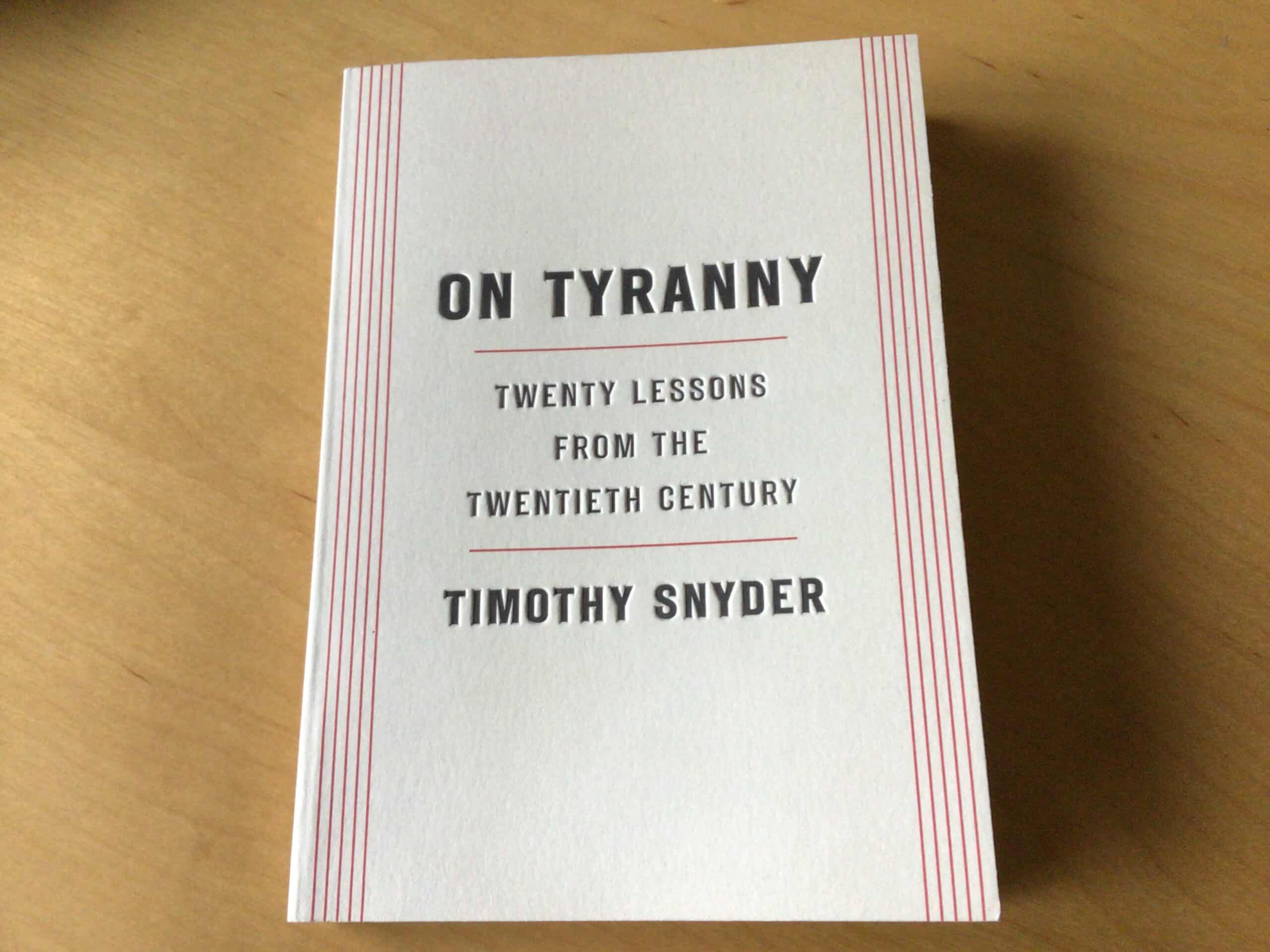
Today’s entry into The Grim Reader is a slim little volume called On Tyranny: Twenty Lessons from the Twentieth Century by Timothy Snyder. And when I say slim, I mean it. It’s an essay, really. It clocks in at 126 pages but the book is only 6″ x 4″. Tiny. Yet, it has a lot to say.

I’m breaking the rules because On Tyranny is not about climate catastrophe. But tyranny will only add to the catastrophe we face, so I’ll allow it. Also, it’s my blog, and these things will happen from time to time. So today, maybe it’s “The Slim Reader,” not “The Grim Reader.” (That was a really bad joke.)

Many of us born and raised in Canada after WWII are reluctant to think we have been touched by tyranny. I spent decades living in Alberta, Canada. In the early 90’s, I was teaching in a small town where some of the leaders of the brand new Reform movement lived. I was a young thing from Toronto and not having any of it. The brand of politics that has flourished in Alberta since then, nurtured on a poisonous and steady diet of oil, gas, and exceptionalism is not anything I want to be part of.

Inevitably, the politics in Alberta have not stayed in Alberta. They affect the rest of Canada. And that’s not because Albertans are right (no pun intended). It is in our human natures to try to be reasonable and accommodating. We are social animals. We want to stay with the group and keep the peace. We want Confederation to work. No one wants to break up the family. We want to get along. We are people who compromise (in a good way). We want as much “normal” as we can get. And as “normal” shifts, very often, we shift with it. (See Overton Window.)

This might be especially true in Canada where the motto, “peace, order and good government” is one many of us grew up with. We believe in it so deeply, we can’t imagine losing it. Our institutions will protect us, we think. But as Snyder notes, it is the other way around. We have to protect our institutions.

It’s important to note that peace, order, and good government were never true for marginalized people. Indigenous people certainly wouldn’t have accused Canada of having valued peace, order, or good government. Maybe more like “colonization, suppression, and control.”

Anyway. Here’s another way into Snyder’s work. We all know that ridiculous uncle who comes to dinner and drinks too much and spouts off and ruins everything. Then dinner is over and we all have a bad taste in our mouths. But we pretty much get to forget about him until the next gathering, the next holiday, the next wedding, or the next funeral (which, with any luck, will be his but these people seem to live forever even if they drink and eat cheeseburgers every day).

But imagine if you had to have dinner with that uncle every night? Ask an Indigenous person about that. What was it like for them when settlers took over? Imagine if the drunk uncle takes over as host and he sticks you at the children’s table? What then?

Snyder’s advice on what to do when tyrants try to take over is wide-ranging. These are also history lessons. From a warning against “anticipatory obedience” to new authoritarian measures, to urging us to “stand out” in our defiance, these lessons are critical now. He writes, “The moment you set an example, the spell of the status quo is broken, and others will follow.” One person can make a difference. This is the truth that people in power, that tyrants, don’t want you to believe, They want you to feel useless and depressed and despondent. They want you to go along with whatever it is they are doing because what’s the use in trying? We all know you can’t fight city hall.

But that’s not true. You make a difference. I make a difference. Stand up. Speak out.

Don’t worry about what that drunken uncle thinks of you. He’s ruining dinner for everyone, and we all know it. And it’s not his kids’ fault. Don’t blame them. Or his wife. It’s harder for them to stand up to him. They’ve got more to lose. The same is true for your average Alberta citizen who is kind and generous and would be the first to stop and help you if your car broke down, take you home while you wait for the tow truck and offer you a piece of pie and a cup of coffee.

It’s up to you. It’s up to me.

To be clear, Snyder does not talk about drunken uncles. He does talk about Churchill. Churchill stood out in WWII by refusing to give in to Hitler. He didn’t call Poland or France or Austria far away foreign countries that had nothing to do with him. He understood that the fate of those countries was tied to England’s. How did that end? Germany and Hitler were defeated. Churchill did not concede in advance, as others had done. (And please don’t reply with a history lesson. Just read the book and know that I am not doing Snyder’s argument justice with my brevity.)

Snyder also does not talk about Indigenous people and the history of white settler colonialism specifically. But, I feel certain that he would agree that it  was and remains tyrannical and that decolonization is an important means of acting against all tyranny.

Another of Snyder’s lessons is to “Be kind to our language,” by which he means don’t mindlessly repeat memes and clichés. Make an effort to say what you mean in your own way, if only to force yourself to think about it. (Thus, my drunken uncle analogy.)

Snyder’s lessons, while specific to tyranny, apply to all kinds of things. For example, he writes, “You submit to tyranny when you renounce the difference between what you want to hear and what is actually the case.” The desire to retain “normal” at all costs has cost us all. The pandemic rages on, bringing with it more death and mass disability. We continue to fail to make adequate progress on a just transition away from fossil fuels. COP 28 was held in a petro-authoritarian state and pocked with oil industry lobbyists. Sigh.

What would Snyder do? There is so much good advice. Be in the real world, on the street. That’s where change happens. The real work is done in the real world, not on the internet. (I am aware of the irony. But he also says we have access to mass communication tools and we should use them.)

“Make eye contact and small talk.” Talk to cashiers and neighbours and the receptionist at the dental office. Ask them about themselves. Listen to learn. Don’t fail to listen because you are busy thinking about the next thing YOU want to say. Be curious. Connect. Care. What do you have in common? What is it that you both care about? Maybe some day you will talk to them about what they are willing to do to save something important to them and important to you. Maybe some day, you will work on that together.

Snyder’s grimmest moment is when he writes about the average guy, who under the thumb of a tyrant, finds it is his job to shoot people and watch them fall into a mass grave. Or maybe his job is to bulldoze the dirt over the bodies. In another world, he might have been a plumber or a cop. Hey, it’s happened before. It can happen again. He warns people to “Be reflective if you must be armed.” Police forces historically have been put into the service of tyrants with terrible results. Grim indeed.

But also inspirational. His last lesson is, “Be as courageous as you can.” He writes, “If none of us is prepared to die for freedom, then all of us will die under tyranny.”

On Tyranny is must read. I’d be interested to know what parts of it speak to you.

Late add: Thanks to a reader who let me know there is a newer graphic edition which is haunting. Look for it.


Travelling in Troubling Times

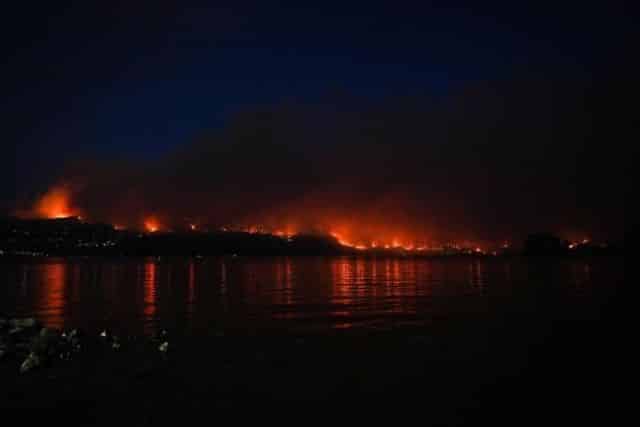
Fires near Kelowna BC. Photo Credit: The Canadian Press.

British Columbia, the province in which I live, has just issued fire-zone travel bans in response to unprecedented wildfires. Evacuations are underway. Non-emergency vehicles are not needed on the roads while people try to escape to somewhere else.

I wonder: how long will any of us be travelling anymore?

I am disinclined to fly anywhere anymore. At least not for pleasure. (But seriously, the pleasure of flying ended a long time ago. Cramped, uncomfortable seats, intolerable security lines, unexplained delays, and so much more have made flying an experience to get through rather than one to enjoy.) For me, the end of masking made flying dangerous to my health. It’s a grand opportunity to catch SARS-CoV-2. A recent study found over 80% of US flights had Omicron RNA in the wastewater, and the number of people coughing or otherwise visibly ill on the two flights I have taken since the start of the pandemic easily convinced me that flying is a bad idea for me unless absolutely necessary.

I took those two flights wearing a respirator and carrying a personal air purifier.

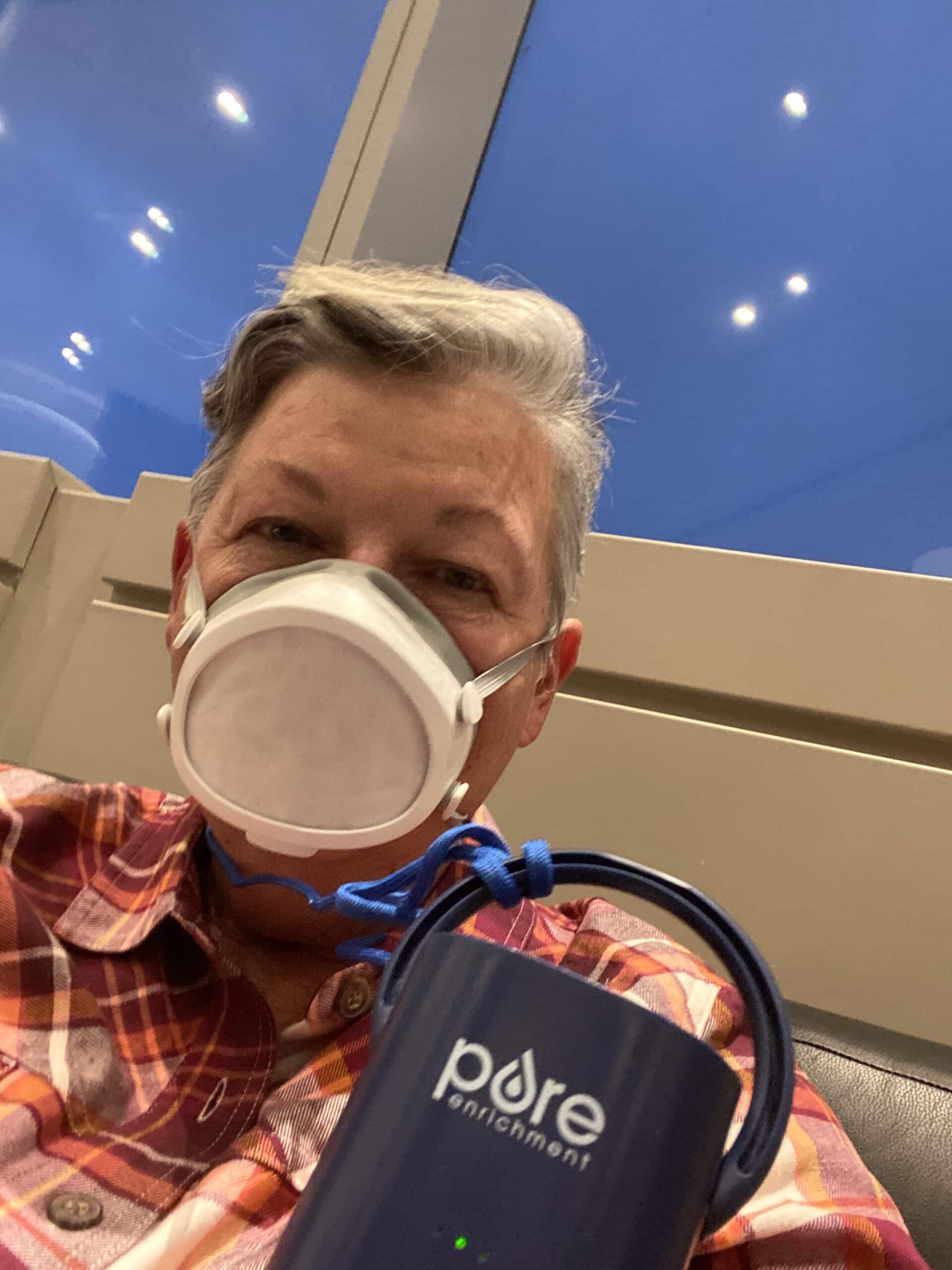
Me, waiting for a flight in November 2022. Funny/Not funny story. I was in the Air Canada Lounge and this woman not 15 feet away from me was having her snack and complaining to her friend that she didn’t even know why she was eating because she couldn’t taste anything. She said, ”Isn’t that weird?” No. Not so much weird as it is SARS-C0V-2. I moved to the other side of the lounge, where, likely, someone else had it too.

By 2019 standards, I looked ridiculous. By pandemic standards, I look just fine, at least to me. (Although I also look disastrously tired in this photo. It had been a long and difficult trip. And I can tell you, people stared.)

But what has really landed me in my own personal no-fly zone is the climate crisis. One of the half dozen or so truly impactful things I can do to reduce greenhouse gas emissions is to stop flying, or at least stop flying except when absolutely necessary.

What constitutes absolutely necessary? For me, the two air travel trips I have taken since the start of the pandemic were to prevent looming family crises. The thing is, we’ve come of age at a time when it is typical to live far away from family, and I do. Air travel made it possible to live like this and still be involved. Sometimes, I will have to travel by air if we want to be in touch on vital family matters. For me, I have decided this is necessary.

If I’m going, if I’m going to burn up all that carbon, I’ll make the absolute most of it. I combined the first trip with a book tour. To be clear, I would not have taken the book tour to Toronto if there also hadn’t been important family matters to attend to.

A vacation with air travel is a whole other thing. I can’t justify it anymore.

This summer, my partner and I drove our hybrid vehicle on our vacation as we camped and visited friends. Nothing is perfect, you know? Driving is better than flying. But it’s not great. There’s no holier than thou going on here. (One of my new favourite expressions is ”granolier than thou.”) I am by no means the person who lives an exemplary life. Like all of us, I’m struggling to learn how to live in our new pandemicene era. I’m just sharing one of my own personal decisions, a judgement I made for myself—not for others.

It’s a privilege to travel in so many ways, one which I acknowledge and am grateful to have had. I am giving up a privilege. I’m not giving up clean water. But it’s also not like giving up turnips, which I do not like. That would be easy to do. I’m giving up possibility. I’m giving up something with positive associations. It’s been a long journey to first recognize and then deal with the new negative associations. And the airline industry hasn’t helped. I would get daily offers from Air Canada and Aeroplan in my inbox. I finally unsubscribed.

And what about driving? Some of the areas of BC that we travelled through by car this summer are now, just a few weeks later, ablaze. Our road trip did not help. I’m grappling with that. Earlier this summer, I read a news story about planes full of tourists continuing to land in Greece even though the country was in a state of emergency because of wildfires. A sister of a friend is flying to Maui in September. It just feels bad to me. It feels bad for me. It is not something I would do. Again, I make that judgement for myself. I’m not saying no one should ever go to Maui or Greece again. They depend on tourism. Or at least they have until now.

Now it seems they need their resources for themselves. Last November, we drove through the region where Lytton is, and there were signs asking people not to visit. Of course, we did not go there. I get it. No one needs a bunch of lookie-loos. People need to grieve, to regroup, to kick the ashes. And they don’t need me trying to buy a sandwich while they do it.

So, for now, rather than travelling in troubling times, I’ll be staying close to home. I’ll be revelling in the joys of the here and now, in the small pleasures of my glorious neighbourhood. That’s not anything to be upset about.


Book Recommendations for Mother’s Day

This morning, I happened upon a tweet by Jael Richardson who expressed that she’s not too keen on what she’s seeing on book recommendations for Mother’s Day. I responded, interested in what she would recommend.

Richardson’s point is that she wouldn’t make a different recommendation to mothers than she would for anyone else. She writes, “My favourite books for ‘mothers’ are my favourite books for people.” Yep, true. She objects to the spring time covers and so on, and is asking people to think about what the marketers think a “Mother’s Day book” is. It’s a good and important point to make.

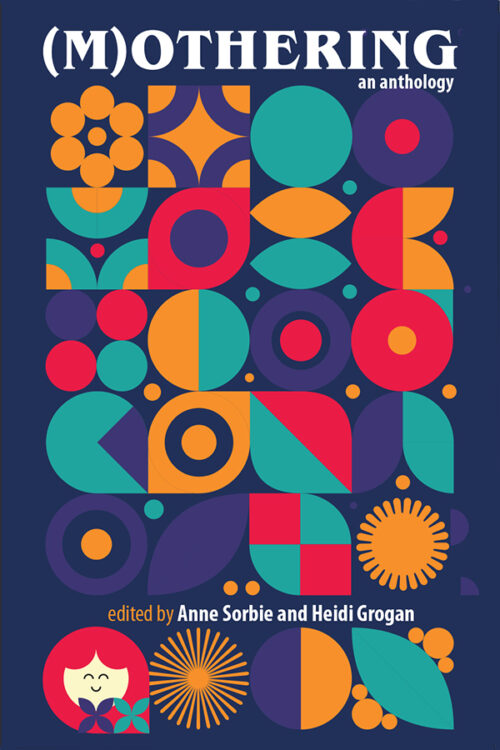
Cover of (M)Othering, a new anthology edited by Anne Sorbie and Heidi Grogan

Some of the other tweeters on the thread point out that Mother’s Day recommendations can be triggering, and this is so true for people who struggle with infertility or who have lost a child or children or have experienced any of the myriad things that can happen. Anne Sorbie, editor of the upcoming (M)othering Anthology with Inanna in Spring 2022 (with Heidi Grogan) has as inclusive an approach to mothering as I do and says in her tweet, “All people are and do (m)other” to capture that inclusivity. I had recommended her upcoming book in my reply because, well, I’m in it, and I think it’s a logical Mother’s Day book recommendation. I am certain it will be inclusive and wonderful.

The flip side of Richardson’s point is that books about mothers are good for people.

I can’t help thinking that sometimes readers are looking for books that reflect their reality. Sometimes, it is helpful, (and not to be too dramatic) even life-saving, to find someone else who captures something of your experience with their words. A colleague of mine, Diana Gustafson, edited a book called “Unbecoming Mothers: The Social Production of Maternal Absence,” which was groundbreaking and, if it weren’t so darned hard to find now, would be a great Mother’s Day recommendation. It’s about the stigmatization of mothers who come to live apart from their children, for whatever reason. Mothers who give up, surrender, or abandon their children are among the most stigmatized.

What we do to mothers. (Shakes head.)

So, while the recommended books for Mother’s Day may be problematic, it is part of a bigger problem: Mother’s Day itself is problematic. It’s not literally a Hallmark Holiday, but it might as well be. It’s easy to create a situation in which people feel excluded and judged. It becomes the opposite of celebratory. Most problematic of all is the way our culture thinks about mothers, limits them, expects too much of them and offers very little by way of support. Even the notion that mothers are women is, thankfully, being deconstructed as we challenge gender constructs and stereotypes. All of this is welcome.

I also can’t help thinking that marketers are gonna market. Any opportunity to recommend books will be seized. Let’s try and be thoughtful about it.

Tis the season to think about Food Banks

Canada’s first food bank opened in Edmonton in 1981. People were hungry and the social safety net had failed them. Capitalism had failed them. Government had failed them. Maybe schools and employers and families and neighbours had failed them. Maybe they had failed themselves. Whatever the cause, people were hungry. Families and their little children were hungry. And so, as often happens, churches and charitable agencies stepped in. Individuals made donations. A system of redistributing food was developed. Perhaps you donate to a food bank. Many of us do. CBC Toronto is having its giant annual food bank drive today. I hope they raise a ton of money. No one wants a child to go hungry, or at least no one I would care to know wants a child to go hungry.

BUT —

Food banks were originally going to be a short-term response to immediate need. Once the limitations and failings which had enabled hunger to exist were addressed, food banks would no longer be needed and would disappear. That was 36 years ago. More than a generation has passed and food banks are everywhere and still absolutely necessary. They are an institution.  To borrow a phrase of Jean Swanson’s, Vancouver’s tireless anti-poverty activist, we have substituted charity for justice.

Let that sink in a minute. We have substituted charity for justice.

If you are donating to a food bank this year, I truly applaud you. Could you do something else too? Could you work a little on the justice part of this problem? Pick a piece of the source of this massive issue to tackle. If you think capitalism is the problem, think about what you can do to reverse trends that have placed resources in the hands of some while impoverishing others. Get involved in a community garden. Read about food security. Decide how you can contribute to creating food security for all. There are lots of people who have opinions and thoughts about what to do. If you think government is the problem, ask your representatives what they are doing to alleviate hunger. We get tax deductions for our donations. Maybe we shouldn’t. I don’t know. I don’t know all the answers. I’m only one person and I can’t solve local hunger by myself, let alone global hunger. But that’s no reason to avoid drawing attention to the problem or taking one small action beyond a food bank donation.

Here’s a little reading list, a little food for thought.

George Monibot, “Everything Must Go.”

Art Eggleton, “Three Ways to End Poverty in Canada.”

Canada Without Poverty. “Human Rights and Poverty Reduction Strategies.”

Jean Swanson, “Poor-Bashing.”

Elaine Power, “It’s Time to Close Canada’s Food Banks.”

Feel free to add other helpful reading materials in comments.