Suggesting Comps (and self-esteem)

The most difficult thing I’ve been asked to do as I prepare to publish my first novel, Patterson House, is to offer comps, or comparable titles, to the publisher, Inanna. I’ve been trying to sort out why this has been so hard.

I’m widely read in my genre. I wrote the kind of book I like to read. So it’s not that I am unaware of other historical, multi-generational, family sagas. I know of many. I can list them in seconds. I think the problem is that they are all so good. I’m talking about classics like my all time favourite novel, The Stone Diaries, by Carol Shields. Or Fall of Your Knees, by Ann-Marie MacDonald. These books are almost sacred to me, I love them so much.

Not only are they comparable because of genre, they are comparable because of their use of multiple points of view. It was natural for me to weave multiple POVs into my story. I had to fight to retain them in the draft I worked on during my MFA. I was told repeatedly to keep it simple. I did not. How can we know anything without looking at it in multiple ways? (And the more ways, the better.)

These books are also comparable because they are sociological–that is they are as much about the society around the main characters as they are about the characters themselves. I come from a school of thought that says everything is political. Because everything is.

But it would be hubris in the highest degree to compare my work to this work. The most I can say is that these books inspired me. And they did. They made me want to become a writer. I can hear someone out there saying, “Well, she’s no Carol Shields, I’ll tell you that.” It’s okay. I already know.

I did a little searching and read a blog post by Paula Munier about comps that I found quite helpful. Maybe you will too. Between that and a friend suggesting The Bean Trees by Barbara Kingsolver as a comp (again, another big name I can’t possibly use), I came to realize that I could focus on theme. Maybe something like women finding new models of motherhood or the intimacy of women’s friendships and the great loneliness of life without them. Munier’s post taught me that it might be acceptable to list a well known best-seller, but only one, and then add a mid-list author (a phrase I despise for it’s dismissiveness) and another first time novelist to the list.

Again though, I seem stymied. For example, I admire Katherine Ashenburg’s gorgeous debut novel, Sofie & Cecilia. Like my novel, it is historic. We are working out similar themes–what it costs women to maintain marriages and families and to retain their respectability, and the pain experienced by women who are unable to use their talents. But Ashenburg was published by Knopf and her novel had huge success. All deserved. I can’t compare my effort to hers. (I highly recommend you read it. It’s beautiful. Her deep knowledge of Swedish art is just one astonishing feature of her novel.)

So what is my problem?

What I’ve discovered is that my inability to suggest comps is, more than anything, a self-esteem problem. And who can solve that?

The Plague and the pandemic

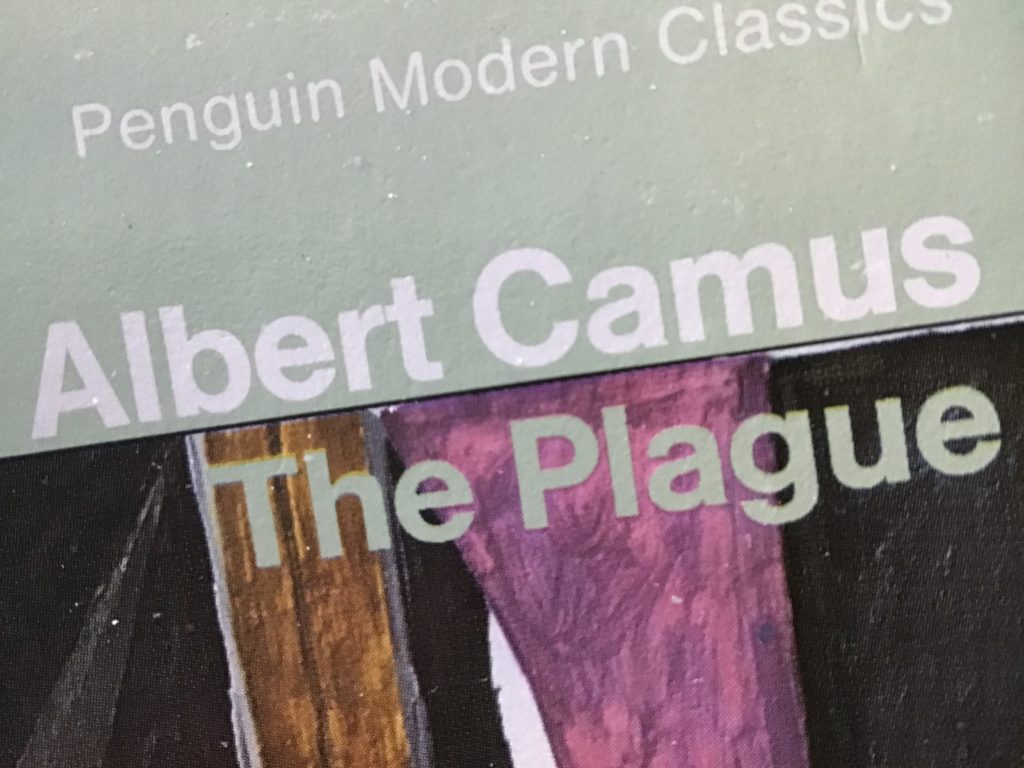
I’ve been reading The Plague by Albert Camus. I’m reading the Penguin Modern Classics edition, translated from the original French by Stuart Gilbert. The parallels between the plague imagined by Camus and our pandemic today are not perfect, but they are striking.


As the plague begins, the people of the town of Oran are not taking precautions. The narrator notes, “Our townsfolk were not more to blame than others, they forgot to be modest—that was all—and thought that everything still was possible for them: which presupposed that pestilence were impossible.” (34) What an interesting word—modest. The narrator goes on, “They went on doing business, arranged for journeys, and formed views. How should they have given a thought to anything like plague, which rules out any future, cancels journeys, silences the exchange of views? They fancied themselves free, and no one will ever be free so long as there are pestilences.”

What a thought. Fancied yourself free, did you? A plague will put that to rest. So will a pandemic.

The last time the people of Oran said goodbye to their loved ones, their friends, their colleagues, or anyone at all, they had been quite sure they would see them again soon. They were “duped by our blind human faith in the near future and little if at all diverted from their normal interests” by early evidence of the plague. (57) Sounds familiar.

I can’t help wondering about my last leave-taking of my daughter. Was it good enough—that is, good enough to see us through our current exile? But how could it be? Love is an every-day thing, a minute-by-minute grace. It can’t be hoarded and then meted out by the teaspoonful, hoping to make it last until more love is available. It’s not like flour or bananas or toilet paper.

And that is why, perhaps, Camus philosophizes about the nature of love as the novel starts, about the very purpose of our lives. His townsfolk sleep-walked through their lives before the plague. “The truth is that everyone is bored, and devotes himself to cultivating habits. Our citizens work hard, but solely with the object of getting rich. Their chief interest is in commerce, and their chief aim in life is, as they call it, ‘doing buisness’. Naturally they don’t eschew such simpler pleasures as love-making, sea-bathing, going to the pictures. But, very sensibly, they reserve these pastimes for Saturday afternoons and Sundays, and employ the rest of the week in making money, as much as possible.” (5-6) And then they “fritter away” the rest of their lives at amusements. Perhaps his most damning condemnation of them is when he says that they “love each other without knowing much about it.” (6) The narrator takes pains to explain that, aside from some unique geography, the town of Oran could be any town in it’s banality and complacency. And so, Camus gives a description of all of us.

What really strikes me about the book is how well Camus captures the early days of the plague, days much like what we have been through in the past two months. The townspeople “were in a quite exceptional state of mind and, though in their heart of hearts they were far from recognizing the enormity of what had come on them, they couldn’t help feeling, for obvious reasons, that decidedly something had changed. Nevertheless, many continued hoping that the epidemic would soon die out and they and their families be spared. Thus they felt under no obligation to make any change in their habits, as yet. Plague was for them an unwelcome visitant, bound to take its leave one day as unexpectedly as it had come. Alarmed, but far from desperate, they hadn’t yet reached the phase when plague would seem to them the very tissue of their existence; when they forgot the lives which until now it had been given them to lead. In short, they were waiting for the turn of events.”

We all know people like this. The refuseniks. The ones who won’t socially distance. The ones who keep arranging dates on Bumble. Think of Georgia, reopening barber shops and bowling alleys. Think of the zombie-like crowd pounding on the doors of the statehouse in Columbus, Ohio, demanding…what? Demanding an end to the pandemic? Demanding their government ignore the pandemic and allow them to continue on with life as usual?

Camus saw it all, way back in 1947.

He writes, “At first the fact of being cut off from the outside world was accepted with a more or less good grace; much as people would have put up with any other temporary inconvenience that interfered with only a few of their habits, but, now they had abruptly become aware that they were undergoing a sort of incarceration under the blue dome of sky, already beginning to sizzle in the fires of summer, they had a vague sensation that their whole lives were threatened by the present turn of events, and in the evening, when the cooler air revived their energy, this feeling of being locked in like criminals prompted them sometimes to foolhardy acts.” (85)

Another startling correlation to today in The Plague is that those who speak truth, those who speak cautiously, those who ask for restraint, are condemned. As Camus notes, “there comes a time in history when the man who dares to say that two and two make four is punished with death.” (111) And so we see in our own time how the knives come out for the scientists. Dr. Tam is pilloried and subject to racist attacks. Why? Because she dares to say that two plus two equals four. Meanwhile, the provincial government sends out its recommendations in increments, afraid to be the bearer of the terrible news that, “No, school will not reopen this year.”

In terms of what the plague means, it has no clear meaning. If anything, it means “the same thing over and over again.” (134) Our days are the same, our activities limited. But if we are honest, weren’t they always? This is the point Camus makes at the start: we live repetitive lives, confined by the dictates of forces around us we fail to recognize. We swim in David Foster Wallace’s water and fail to even notice that we are drowning in it.

In the fictional plague, it seems that regardless of precautions, “sooner or later contagion did its work.” (145) I can’t accept the nihilism of that particular observation. We have proof already that we can limit the damage. But like the townsfolk of Oran, we whine. Can we re-open? Can we go back to normal. We assume, wrongly, that normal is there waiting for us. But normal is gone. Normal is something we can’t go back to. We behave like children in the back seat of the car, hitting our brother and whining, “Are we there yet?” No, we are not.

“The truth is that nothing is less sensational than pestilence, and by reason of their very duration great misfortunes are monotonous.” (148) It will not end soon. We are a year or more from a vaccination, if there ever is one. Meanwhile, as Camus says, “the only means of fighting a plague is–common decency,” which the character of the doctor describes simply as doing his job. (136) If there is one thing I believe in, it is common decency. So I must do my job. That is, stay in. Socially distance. Don’t whine.

We are a long way from the doom that ultimately descends on the townsfolk of Oran. After months of plague, “only shadows remained to them of what their love had been and meant, they now came ot learn that even shadows can waste away, losing the faint hues of life that memory may give…. In this respect, they had adapted themselves to the very condition of the plague, all the more potent for its mediocrity. None of us was capable any longer of an exalted emotion; all had trite, monotonous feelings.” (149)

The struggle, our sturggle, is not merely to remain indoors, to socially distance, to obey the best policies laid down by public health officials, (although that is a struggle to be sure). The struggle is to remember all that is truly good and important in life.

There were flaws in our lives before the pandemic. We were, as the townsfolk were, lost in some kind of neo-liberal fantasy. The bubble has been burst. The pandemic has shown us ourselves, our failure to care for the most vulnerable, the utter foolhardiness of our notions of economic strength. It has shown us what was wrong with how we were. As Camus notes, “destruction is an easier, speedier process than reconstruction.” (218) We took our normal lives apart fast–faster than any of us could have imagined. When we put them back together, lets all take care to ensure we build something we actually want. We have time–right now–to imagine what that might be. Let’s take it.

Paying Writers with thanks to the Canada Council for the Arts and St. Michael’s Hospital

Our book, Impact: The Lives of Women After Concussion has received funding from two sources: the first is St. Michael’s Hospital and the second is the Canada Council for the Arts. I had the great good fortune of distributing the Canada Council funds to our contributors today. We (E.D. Morin and I, and all of our contributors) are so grateful to the Canada Council for the Arts for supporting our work and enabling us to pay creators.

It is hard to overstate how difficult it is for writers to get paid these days. This could be a whole post in and of itself. But let’s stick to anthologies. Here’s something most people don’t realize: typically with anthologies, contributors don’t get paid. Royalties can be shared among contributors, but the math doesn’t make it worthwhile. So the editor gets paid royalties by the publisher and the rest do not.

How much money are we (not) talking about?

I don’t want to brag or anything, but E.D. Morin and I split just over $1000 in royalties for the last anthology we did together, Writing Menopause. I know. You’re underwhelmed. Remember, that represents several YEARS of work. We had over fifty contributors for that book. I give you the numbers so you see the problem. We can’t blame publishers for not wanting to get into this level of paperwork for such small sums. What happens instead is that most writers get paid in copies of the book. Two is typical. Three or more is considered a good deal. It’s better than nothing. But we all know, we can’t trade our books for groceries at the local market.

So when E.D. Morin and I started work on this anthology, we vowed we would find money somewhere to pay the writers. And the quest began. Databases were searched. We consulted with colleagues like Rona Altrows who is on a similar quest to pay anthology contributors and has been successful.

We were turned down by lots of people. It’s hard to get a grant without an organization behind you. There is a process of proving oneself (over and over again) that is difficult and sometimes even demoralizing. It’s the same as looking for a job, and maybe not quite as bad as looking for a bathing suit. At least I didn’t have to do it half-naked and in bad lighting. Anyway, we had to have a lot of stamina. But we get it. There’s no free lunch and anyone giving money out has to know that we can follow through and deliver on our promises. Our success on our last anthology (earnings notwithstanding) helped us to find funding with this project. We had a track record.

And then we found success. First, because of the content of the anthology, we got interest from St. Michael’s Hospital, who have a wonderful and renowned head injury clinic in Toronto and are an important centre for research. They recognized that our contributors were breaking new ground and as a result, they created a research project based on our anthology. And, as part of their funding, they included money to pay our writers as participants in the project. To know that our anthology will impact (pun intended) the treatment of women with concussion is an incredibly positive outcome and we thank, in particular, Dr. Shree Bhalerao and his team for their enthusiasm and support.

Then came the Canada Council for the Arts. Their grant officer was so helpful as I navigated their forms and process. Remember, I’ve got a concussion too, and about the hardest thing for me to do is use websites and fill in forms. When we received notification that the grant had been approved and awarded, we felt not only relief about being able to offer our writers a significant payment, but also gratitude for the recognition that what we are doing has artistic and literary merit. Thank you, Canada Council for the Arts.

It’s not easy, but it can be done. Writers must be paid. Not every project is this content specific. We had avenues of funding that were unique to us and would not be available to others. But we thought about our project in new ways to get where we are today. In the hard times ahead, we are going to have to be even more dedicated to supporting creators.

We can’t wait to share the results of this work with you.

Concussions and Writing: Impact

My long neglected website. Given the lack of attention it receives, a person might be forgiven for thinking I was dead. In the immortal words of Monty Python, I’m not dead yet. But I’ve had to make hard choices about where I spend my writing time. You see, as I started working harder on the concussion book, the concussion symptoms returned. The irony is not lost on me.

My neuropsychologist suggested I did too much. Clearly she’s right. But for the record, I waited three years to take on a project in which others depended on me and deadlines mattered. I did what I was told. I rationed my screen time and my reading time. I added to it slowly. I was careful. I now know that I will never again be able to work long hours. I will never enjoy the satisfaction of working obsessively. I loved working obsessively.

The book is so worth it. No regrets. What I’ve learned from the women contributing to “Impact: The Lives of Women After Concussion” in the last few months has been so consoling. Their insight into our condition (concussion, post concussion syndrome and various levels of traumatic brain injury) exceeds anything I’ve learned from doctors or other health professionals in the last three years. I’m so grateful to them.

I have also had to confront my internalized ableism. Why is it that I have been so very reluctant to classify myself as disabled? Am I entitled to such a classification? Does what happened to me count?

Usually, I pass as a person with a normally functioning brain. (I’m trying not to insert an ableist joke here.) Mostly, I’m glad about passing. It’s easier. For one thing. I don’t want to talk about my issues all the time, although I’m sure some people think I do. Then, I start stuttering again, or wince at a loud noise that no one else notices, or have to flee from a store or busy restaurant, and I feel I need to explain myself.

Why do I think I need to explain myself? I see the difference in myself more than anyone else does. I’m the one who notices. When I had cancer, I could also pass. That is, I could pass until my hair fell out. Once my hair fell out, there was no hiding the fact I was seriously ill. I could wear a wig or a hat, but that was a disguise. With post concussion syndrome, even when I’m doing well, I’m always waiting for the wig to slip. Because my symptoms appear unexpectedly, I am suddenly exposed. I can’t pass anymore. It’s disconcerting. And it happens at the very worst times–times when I’m already stressed and busy. Of course.

So I tried an experiment. I talked about the surge in symptoms. A lot. I was very frank with people. I tried to be as frank as the women whose work I am reading. I tried to get comfortable with it. I can’t say it has worked. Not yet.

***

Impact: The Lives of Women After Concussion is coming mid 2021.*

Addendum: The title of the work changed to Impact: Women Writing After Concussion

New Project: “Impact: The Lives of Women After Concussion”

Elaine Morin and I are co-editing a new anthology tentatively called, “Impact: The Lives of Women After Concussion.” Is there anything more optimistic than starting a new writing project?

The enthusiasm from the writers we have invited to contribute is so encouraging. It’s an important topic, and a hot topic. There are all kinds of reasons to focus on women’s experience of concussion. A recent article in the New York Times offers a few insights into why. And our book will offer more.

Elaine and I have been sharing concussion stories for a long time, tinkering with the idea of an anthology. It’s a lot to take on. We know this because we’ve done it before. Speaking for myself, it will be slow and hard work, but I’m ready. Knowing everyone involved “gets it,” knows that there are good and bad days and times the return of an email might be a bit slow is a big stress reducer.

It’s strange how when you begin to put something “out there,” it can get reinforced in so many interesting ways. I don’t mean to sound flaky, but this is exactly what is happening to us. There is a quote often misattributed to Goethe,

Until one is committed there is hesitancy, the chance to draw back, always ineffectiveness. Concerning all acts of initiative (and creation), there is one elementary truth, the ignorance of which kills countless ideas and splendid plans: that the moment one definitely commits oneself, then Providence moves too.

All sorts of things occur to help one that would never otherwise have occurred. A whole stream of events issues from the decision, raising in one’s favour all manner of unforeseen incidents and meetings and material assistance, which no man could have dreamt would have come his way.

Indeed. We have met and spoken with so many concussed women writers and they all have such profound things to say. We can’t wait to show you the results of our work.

Concussions and Confined Settings

I’m reading concussion stories, and my colleague Elaine Morin pointed out Lauren Groff’s excellent story in the New Yorker, The Midnight Zone. It’s full of truth and suspense and fractured thoughts and a fractured head and it took me, inevitably, to the reading of an interview with Groff, which was (sadly, for my purposes) more about motherhood than concussions, although both topics are writerly obsessions of mine, the former being a thirty-year obsession and the latter much newer.

(I read that last sentence three times, by the way, and it is technically grammatically correct. It is representative of the tangential way my mind works these days, and I’m keeping it as is. Welcome to the inside of my head.)

In the interview, Groff makes a great point about setting. The setting of the story is confined to a small cabin. Danger lurks outside, but also liberation. Asked about this, she says, “it’s psychologically easier to live if you believe you have an exit plan. It’s easier to run ten miles if you tell yourself that you can walk when you get to eight; it’s easier to work for four hours without a break if you keep the door to your office open; it’s easier to live with how we’re killing the planet if you believe the completely insane notion that humans will colonize Mars.”

She’s so right. And I love the way she extends the situation of the story to the much larger world. But back to concussions. Three years (plus) into this brain injury, I am still keeping the door open. It’s easier to live that way. It’s behind me, back there somewhere, even as I stare down the very real possibility that this is as good as it gets for me. Concussion and confinement go together. Concussed people avoid light and sound and people and life. I wonder if Groff made that connection? Do you ever wish you could talk to a writer and ask these questions, go deeper into something you find fascinating in their work?

Suffice it to say, I am now a Groff fan. Maybe one day I will get to talk to her about how she knows so much about brain injuries. Until then, I’ll keep reading concussion stories.
