Tag Archives: Yukon

Report from the Road

The problem with telling all 3 of your blog followers that they can follow along on your trip to the Yukon is that there’s hardly ever any cell coverage! Here’s a report from the road.

What we’ve seen:

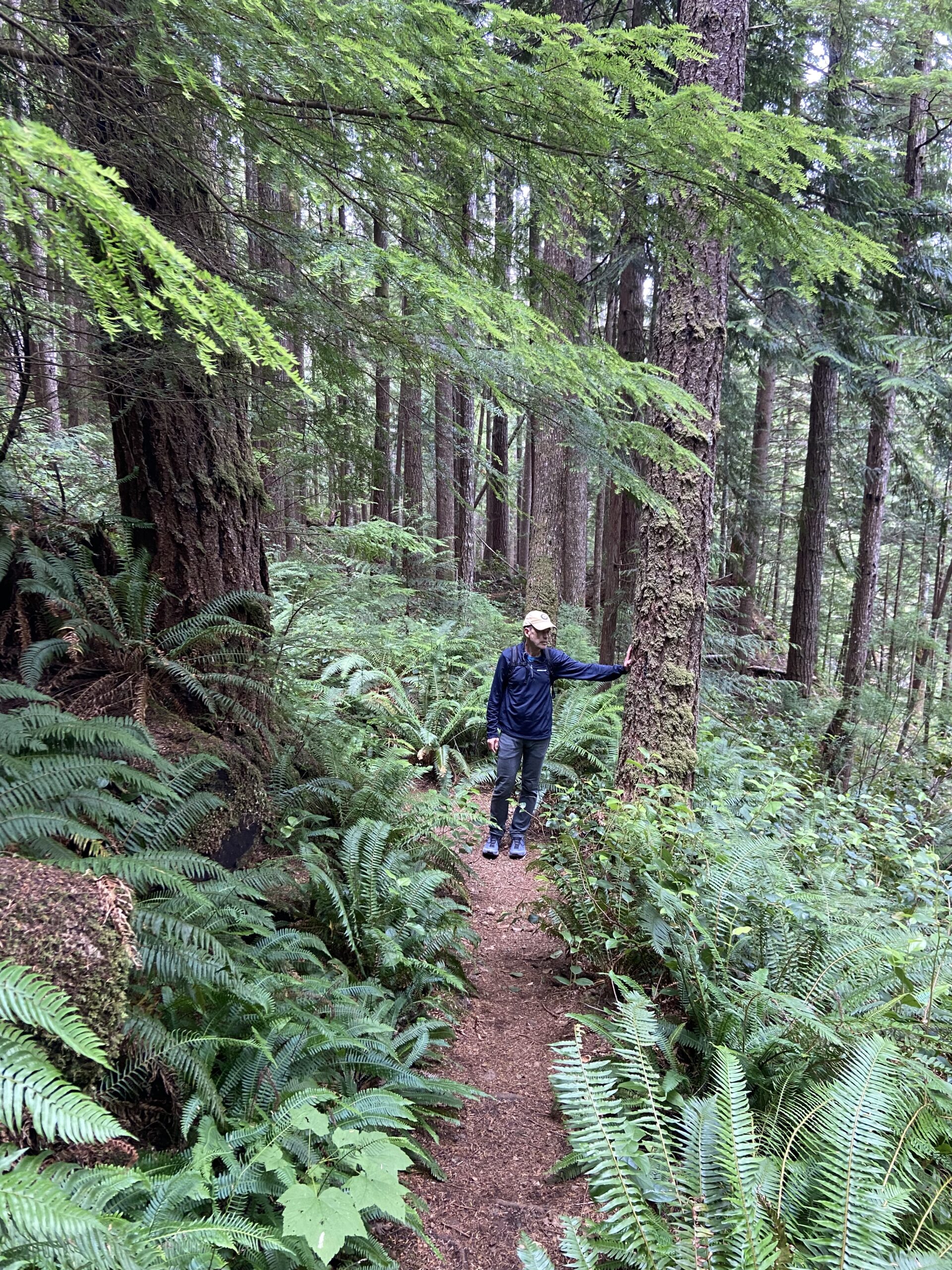
Forests. So beautiful. Joy bringing! We’ve moved from the forests on Vancouver Island to the true boreal forest in all of its vastness. Such joy! And its complicated joy interspersed with the grief of ragged clear cuts scarring the mountainscapes and one close brush with a fire. It burned on one side of the highway while on the other side, right beside us, a water bomber loaded up from the mighty Skeena River. There were lots of fire fighting personnel there. We should all be grateful to them.

So. Many. Whales. We took the inside passage to Prince Rupert and saw so many whales we lost count. Mostly humpback. I would say they were cavorting. Out there having fun. I am so happy to see them.

Mountains. They’re getting taller. We see snow up there now.

Totem poles. We were in a village full of totem poles. Gitanyow. Amazing. Spooky.

Quiet. It’s so quiet. As I say that I’ll make it a lie by saying I hear owls at night. I hear the flapping wings of birds.
Every once in a while, I’ve heard little kids laughing so hard—a fantastic sound.

Fishing. Although so far my record is terrible, I still love it and my casting is improving.

Rivers. I had no idea how big the Skeena is. It makes me realize that Canada is so big, there are massive rivers we barely know about.

My new saying is, “when you’re towing a trailer, you’re always close to home.”

Here are a couple of random pics. I’ll post again.

Great campgrounds

Mosquito Mania

It’s a bad year for mosquitoes, especially in the Yukon.

The biggest mosquitoes I’ve ever seen in my life were in Watson Lake, Yukon. We arrived there in the VW Camper sometime in 1993, our daughter still tiny, and had to set up camp without any of us getting eaten alive. The air was thick with them and we sat inside our van making a plan. We had the handy “Pack & Play” playpen which we usually popped our kiddo into to keep her safe while we got organized, but this time, we had to absolutely cover the playpen with mosquito netting. I joked they could carry her away. We’ve never moved so fast. When we were ready to bring her back inside the van, we did a rock/paper/scissors to see who would go out in the swarm.

She did not have a single bite. A proud parenting moment indeed.

Fun fact: I recently learned that caribou behaviour is very much determined by mosquitoes. Like us, they want to get away from them. That’s why they hang out on ridges where the wind might give them some relief.

Another fun fact: The best advertisement ever created in my opinion was for Off. Remember the bare arm in the clear cage swarming with mosquitoes? That poor arm. But then, the arm goes back in, this time, sprayed with off and … voila! They don’t bite! They don’t even light!

FYI: My husband likes to claim that his uncle Jim was the man with his arm in the cage, which is hilarious and I’m not saying if it’s true. But try making the claim if you need to liven up a social situation or are playing “Two Truths and a Lie.” It’s a good one. (But which is it? A truth or a lie?)

DEET is allegedly okay to use says a recent NYT article. People worry that it causes cancer or whatever, but the worst thing about it seems to be the smell. Says the expert in the article: “The whole point of smelling unpleasant is you’re not the only one that thinks that….Insects do, too….That includes other bugs like ticks, fleas and biting flies.” The risk of insect borne illness is probably worse than the risk of DEET. In a nut shell, says the article, don’t use more than recommended, don’t spray it in your eyes or mouth and definitely don’t swallow it.

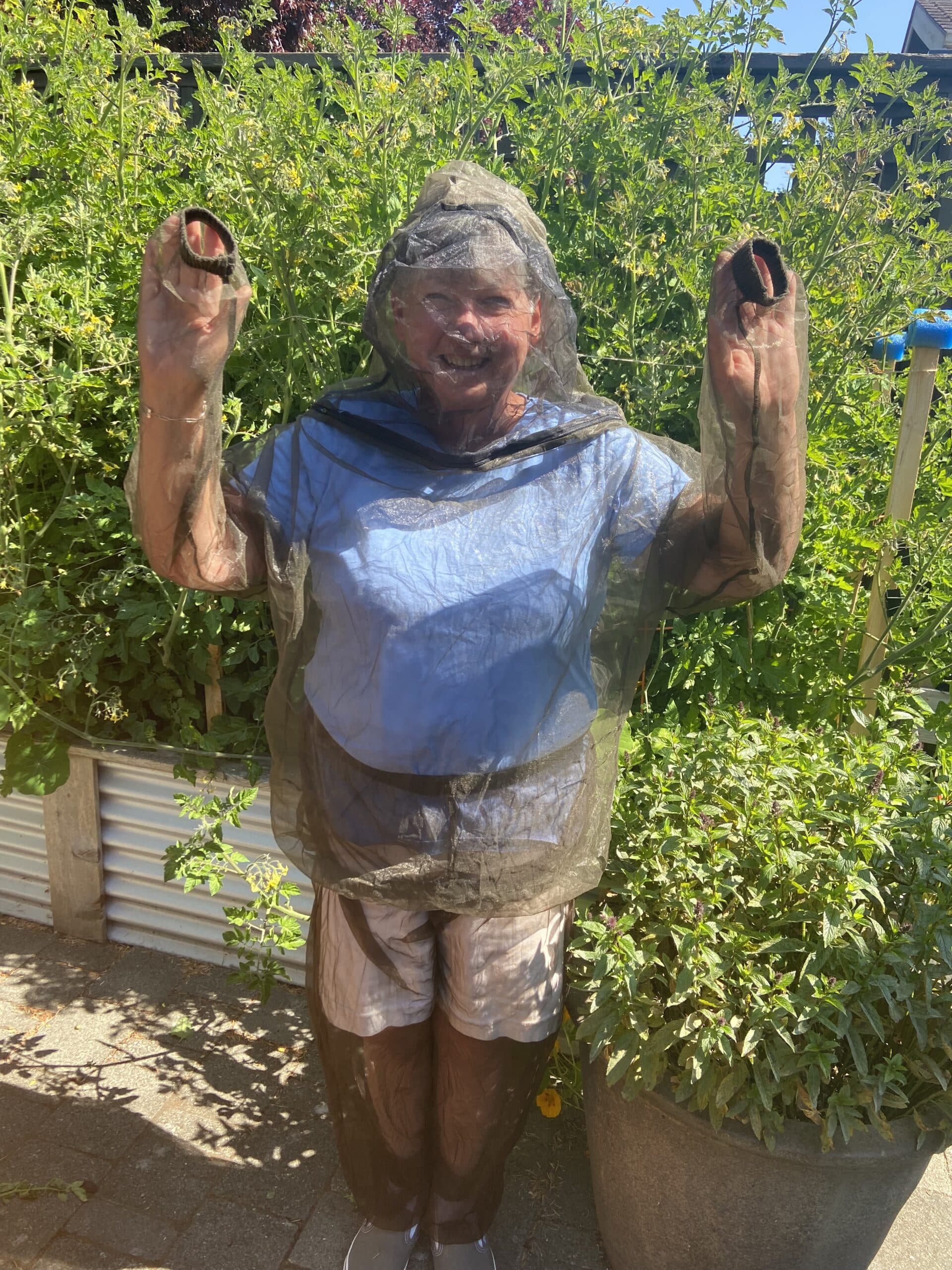
DEET does smell terrible and also leaves my skin kind of sticky. Between that and the sunscreen and not knowing when my next shower might be, it all gets a bit much. So I tend to spray it on my clothes instead of directly on me, especially on my hat. But DEET is no match for Yukon mosquitoes. I know this already. So I have the suit. I will be a kind of superhero in it, repelling mosquitoes.

By the time I come home, I imagine my mosquito suit is likely to have been enhanced by duct tape. It will get increasingly ridiculous. But I believe in the mosquito suit. My suit will protect me. I’ll repeat it like a mantra.

Behold me in my glory!

Me in a mosquito net suit.

Me Mosquito Free

Sad news from Dawson City, Yukon and Disaster Tourism

The Pit, the old Westminster Hotel in Dawson City, Yukon, has burned to the ground.

Built in 1898, it was sometimes thought of as the “living room” of Dawson City. I’ll never see it. Sad.

It had already been closed because of a terrible flood, but hopes were high that it would reopen this summer. What is a flicker of sadness for me is a deep gash in the lives of those in Dawson City. I’m going to make a bold, even over-the-top comparison. It is like when Notre Dame burned down. For Parisians with a lived connection to the Cathedral, it was soul crushing. For tourists, it was sad, but not the same. The Westminster Hotel was that important to Dawson City.

The loss of the Westminster Hotel has me thinking about how everything seems to be changing so fast and what some people call disaster tourism, a desire to see something before it’s gone. Get to Taiwan while it is still Taiwan. Go north and see the polar bears before they go extinct. I think of the tiny town of Lytton, BC, still reeling and not rebuilt from the wildfire that went through it in 2021. A year later, we were travelling through the area and there were signs up asking tourists not to go there. Disaster tourists. No one wants them. They do not help. And there they are, looking for a sandwich. No one has the time or energy to give them a sandwich. They need all the sandwiches they have for themselves.

There’s so much that is disappearing. Some of it happens because of “natural” disaster, and some of it happens because of shockingly bad policy and politics. According to a recent story, “Climate Policy on the Ropes” by Chris Hatch (Sunday May 17, 2026 in the National Observer), the pod of Southern Resident Killer Whales known as J-Pod that live near me is about to be even more endangered. Changes being brought in by Mark Carney’s Liberal government that eviscerate environmental approval processes and therefore environmental protections are coming so that Carney’s major projects (many of which are pipeline and fossil fuel related) will get passed. Hatch writes,

“Tim Gray, a veteran of the Harper government’s assaults, and now executive director of Environmental Defence, says the [new] proposed process would ‘sacrifice the rule of law and our most sensitive species and ecosystems in order to build pipelines and other projects. If approved, this proposal will take Canada back to a more dangerous, toxic and destructive time and leave Canadians facing impacts that could last for generations.’ Several government sources told [journalist] Althea Raj that the proposal is specifically designed to facilitate projects (like a West Coast pipeline or ports) that would impact the critically endangered southern resident orcas. There are only 74 whales left (perhaps as few as 10 or 12 reproductive females) and they’re the ones that make tragic news every few years when mothers carry their dead babies for days and even weeks in painful displays of mammalian grief.”

And that’s just the Orcas.

According to the World Wildlife Fund, the rate of species extinction is estimated at 200 to 2,000 extinctions per year, which is about 1000 to 10,000 times greater than the natural extinction rate. It’s a big differential, for sure, until you remember that we are still guessing how many species are actually on earth. Every moment we fail to address climate change or demand our governments address climate changemakes us all culpable.

Beyond different plants and animals, land itself is changing. Glaciers are melting. So is permafrost. Deserts are getting larger. Shorelines are expected to continue to change dramatically with sea level rise.

So, if, for some strange reason, you have a wild desire to go see Florida, you’d better go soon. The Everglades are already just a shadow of what they once were. So is the Amazon rainforest. Even the Colorado River is drying up.

[Side note: There is a magnificent essay about the Everglades in Joy Williams’s book, “Ill Nature.” The whole book is great, but the Everglades essay has never left my soul.]

Go before it’s too late. This is the essence of disaster tourism.

I’ve been to the Everglades. It bore no resemblance to what I saw as a child on the TV show “Gentle Ben.” I hiked the Blue Mountains in Australia the season prior to giant wildfires that raged through them and changed them forever. It was not disaster tourism but I was also so grateful I got to see this beautiful place before the worst happened. Not to mention a colony of little penguins along the southern shore of Australia.

What really troubles me about it all is all the effort, energy, money, and even C02 that goes into tourist trips to see the “almost gone” that could go to saving what is. We should put at least as much effort into mitigating the disaster as we do to witnessing it. I am coming to grips with the ways in which I am culpable through my travel.

How much of my desire to go to the Yukon this summer comes from wanting to see this magnificent place as it is now, before it changes (even more) forever? Or is it more simply something I want to experience before I die? How much damage will my trip cause. What is the impulse? Do I want to see a herd of caribou? You’re darn right I do. Muskox? I’d love to see Muskox. We might see Muskox if we were to take a short flight-seeing tour to Herschel Island. Herschel Island is currently being consumed by rising sea levels. The flight seems too much like part of the problem to do it.

But there’s more to my desire to go to the Yukon than ticking off the Muskox box. Have you ever seen the light in Kluane National Park? One of the parts of the trip I am looking forward to the most is a trip through the Mackenzie Delta. I just want to feel what that is like. I want to be in that place. It’s not something I can explain. At least not yet. I anticipate joy in this trip. Lots of joy.

But there will be no Westminster Hotel. My condolences to the people of Dawson City.

Muskox

Muskox

Yukon Trip

I’m going to the Yukon! Or is it supposed to be I’m going to Yukon! With or without the definite article? This is one of those things I’ll find out when I’m there.

It’s a YOLO trip for sure, and I have already been (twice) but I haven’t stayed. These were both “passing through” visits. This time, (the) Yukon is the destination. I’ve always wanted to stay in Kluane National Park and I finally get to.

I won’t be alone. I’m travelling with the best camper ever—Rob. There are several segments to the trip and some of these have special guests. All in all I expect it to take 7 to 8 weeks and I’ve decided to blog it.

We’re not leaving until mid-summer, but I might blog a little about the preparations too. Food Dehydradation? Sure. Why not. Space saving trailer tips? Maybe! Fantastic sights? Definitely. Drinking the Sour Toe Cocktail? Under no circumstances will I drink that. Not a chance.

So, there’s going to be a lot of Yukon content for a while. Get ready!

Wind sweeps clouds of dust over Kluane Lake from the A’ay Chu (Slims River Valley), dried since 2016 glacial meltwater diversion, seen from Tachal Dahl (Sheep Mountain) Ridge, St. Elias Mountains, Yukon, Canada. Hike Sheep Creek trail (10-15 km with 500-1200 m gain or 1700-4000 ft) for spectacular views of the Slims River Valley and surrounding St. Elias Mountains, plus Kluane Lake seen from Soldier’s Summit on Tachal Dahl (Sheep Mountain) Ridge. In a startling case of climate change, over 4 days in spring 2016, the Slims River suddenly disappeared, leaving windswept mud flats creating clouds of dust in the formerly clear air. With its main water supply diminished to a trickle, Kluane Lake may be isolated within a few years, shrinking below its outflow into the Kluane River (which flows into the Donjek River, White River, Yukon River, and eventually the Bering Sea). Kluane Lake chemistry and fish populations are rapidly changing. For the last 300 years, abundant meltwater from the Kaskawulsh Glacier has been channeled by ice dam to drain via the 150-meter wide Slims River, north into Kluane Lake. Between 1956 and 2007, the Kaskawulsh glacier retreated by 655m, which most scientists attribute to anthropogenic climate change. Meltwater flooding from accelerating retreat in 2016 carved a new channel through a large ice field, diverting most flows to the Kaskawulsh River, a tributary of the Alsek, which flows into the Gulf of Alaska. Read more at: https://projects.thestar.com/climate-change-canada/yukon/. This image was stitched from multiple overlapping photos captured in June 2019 by Tom Dempsey / PhotoSeek.com.