Tragically Hip: When you know what you’ve got before it’s gone

How can I keep a blog about writing I love without paying homage to The Tragically Hip and Gord Downie?

The Tragically Hip’s last tour, the news that Gord is dying of cancer, the last show—it’s all too much. My tears are real and close to the surface. And I’m not alone. Many of us have a special relationship with the band. It’s not often we know what we’ve got before it’s gone, and this is one of those times.

I went to Queen’s in Kingston (Arts ’85) when the band was hipgetting started. I had the same hair as Gord. I’ve never met any of them, but I’ve been in the same room. I remember an article about them in the Queen’s student paper. In the interview, they were treated like the Beatles. There was speculation about whether one of them was dead. It was smart, funny. I was hooked. I saved it for years but finally lost it in one of my many moves. I was at a show where they played the song “Bedrock,” from the Flintstones. Seriously. They used to do B-sides of Elvis. I’m not sure how many times I’ve seen them. I think I remember that Gord used to keep his back to the audience way back then. It was kind of great. I imagined him petrified, but doing it anyway, getting out there.
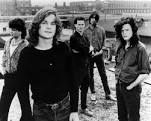
After I left Queen’s, I saw them in Toronto, an early show, at the Horseshoe maybe, or Lee’s Palace. I can’t remember. For a while, he lived in the apartment above a friend of mine. I’d visit and see “G. Downie” on the call button and wonder if I’d run into him on the stairs one day. I never did. I’ve seen them in stadiums in Calgary and Toronto. I took my daughter to see them in a hockey arena in Kelowna. No one stayed in their seats. Most of the audience jumped the boards and danced on the floor. When I hear the lines, “Watch the band through a bunch of dancers,” I am back there.

The last time I saw the Hip was in Boston. I’d been living there with my husband and the crowd at the House of Blues was full of Canadians. Every Canadian in a hundred mile radius was there, or at least that’s what it felt like. We wore our Canadian gear, our hockey shirts, our old Hip t-shirts. The House of Blues folks knew this was some kind of Mecca for us, although they didn’t quite get it. Their songs tethered me, tethered all of us, to home. They made me feel like myself again.

Some lyrics are more poignant now than ever. “You can’t be fond of living in the past,” or “Lower me slowly, sadly and properly, Get Ry Cooder to sing my eulogy.” I love that song. Every time I drive across the country and I leave the Shield and come over that rise on the TransCanada to the Prairie (you know the one) I stop the car on the side of the road, sit on the hood and blast it. In the old days, I’d have a smoke too. Not anymore. Those things cause cancer.

Other lyrics, even the name of the band, have new meanings since the news broke and these new meanings hit hard last night. Context is everything, right? Lines like “Nothing’s dead down here. It’s just a little tired,” and “Tired as fuck.” Yeah. I bet you are. It showed, of course, but it doesn’t matter. “I’m total pro. That’s what I’m here for,” he sang. And he is. “Every day I’m dumping the body,” was a gut punch for me.

One song that didn’t change in meaning for me was “Scared.” I used to listen to “Scared” over and over again when I had cancer. The “I” in the lyric was sometimes me, sometimes cancer. It became a constantly shifting confrontation. I used to go into chemo humming, “I’m not prepared. But if I have to.” Hearing Gord sing it last night was, for me, the emotional centre of the concert.

Thanks for the last memory Gord, the last concert, the epic effort you put into it. Thanks, to you and the whole band, for the last thirty years. I’m not prepared, but I guess I have to. I’m pretty sure you feel the same way.  So do we all.
On Sticking With It

I’m nearly finished a novel. Admitting this spooks me. I’m superstitious that even talking about it will jinx it. Knock on wood. Salt over the shoulder. Fingers and toes crossed. Because nearly finished isn’t finished. And in the oft quoted (by me) immortal words of the great Gord Downie, “No one’s interested in something you didn’t do.” Who cares about a novel that is almost done but not done? No one. Getting it done is what makes the difference between the poser at a party who says, “I’ve always wanted to write a novel,” and the novelist.

It’s been a long process. The wonderful writer Joan Clark mentored me at the Banff Centre when I was just starting this book. She gave me the first thing I needed–encouragement. She told me I could write. She also told me that my biggest struggle would be finishing. She was right on the mark there. But she also reassured me that a lot of first novels take ten years. Well, I’m officially at the ten year mark. A decade. I have struggled not to quit, to stick with it. Somewhere in the first year, I promised myself that even if it was bad and I was the only one who ever read it, I would finish it. And I will.

Many things have stymied me as I’ve done this work. Like all writers, I have this LIFE that gets in the way. It’s hard to stay focused on writing when all this important LIFE is going on around me and I’m expected to be in it. There were times, I admit, when I dropped the novel for months at a time. Months. And when I would come back to it, it was not like meeting a friend who lives far away, a friend who you can pick up a conversation with in exactly the same place you left off the last time you spoke. No. It was like meeting an ex unexpectedly in the grocery store when you are wearing pajamas under your coat and have spinach in your teeth. No matter how intimate you may have been in the past, you and your ex stand before each other as awkward strangers. You might be reduced to talking about the weather. You are estranged, that is, strange to each other. My book and I would have nothing to talk about anymore.

Even worse than LIFE getting in the way of writing was my own lack of skill. I simply didn’t know how to write a novel. I dealt with that by studying, reading great writers, and getting an MFA. It was during the MFA that I finally learned how to work through the massive amount of writing I had accumulated on this project. Joan Clark refers to this writing as “circling.” What she means by this is that we spend an awful lot of time writing stuff that never makes it into the book. We circle the real novel, move around it, explore it from all sides and finally zoom in on it. With the help of other mentors like Sandra Scofield, I figured out how to zoom in, what to cut and what to keep and how to move from scene to scene to scene and get from the beginning to the end.

Now I have a new challenge. LIFE intervenes. So close to the end, I have a concussion. I can’t work much. I lack focus. I risk becoming estranged from my work again. One thing I know, however, is that I have to keep talking to my novel and let it keep talking to me. Even if it’s only a few sentences or words a day, we have to keep acquainted. I read a blog post today on The Hardest Thing About Being a Writer in which Sachiko Murakami talks to Vancouver writer Alex Leslie about how to keep focus on a project. Leslie says, “The one thing I’ve learned is to always keep moving. Never let it all drop. Always be doing something for your project, even if it’s printing it out and crossing out words and writing in other words, or writing a plan. Stay in motion. Give it something.”

Exactly. Every day, I’m going to give it something. Keep it in motion. Give it some energy and get some energy back from it. It’s like circling again. Stay with it. If I can’t be in it, I’ll walk around it and look at it and think about it and dip into it, change a word here and there, and then change it back. I’ll do this until I can gather the concentration to get through those last few pages. I promise. I promise myself. After all, ten years is just an average, right?


On Not Writing

Warning: I’m crabby. I’m about as crabby as I can be. And I know why. I’m not writing.

A few weeks ago I was in a car accident and I have a concussion. This happened despite the fact I did not actually hit my head. Since then I have been learning all about the world of the concussed. One result is I have limited screen time, like some wayward kid given a time out. Three times now, with the merest glint of improvement, I’ve sprinted out of the gate only to stumble in the first few yards. What is that saying about “fool me once….” Three times is really inexcusable. But I get it now. I’m giving myself a few minutes a day, trying to build up the minutes until I can maybe write a paragraph or a blog post or do a tweet or two. Apparently, this is what I was supposed to do all along instead of jumping into a day’s work and then wondering why I became symptomatic again.

I’ve become a little obsessed with a blog called The Hardest Thing About Being a Writer. I ignored it the first few times I came across it. Oh cry me a river, I thought. Writing is so hard. Boo hoo. Then do something else. Whiners, I thought. Yes, writing is hard. But suddenly this blog speaks to me. Writing is really hard. I don’t give myself enough credit sometimes.

Today’s post is about procrastination. Now, to be clear, what I’m doing isn’t procrastinating. It’s something else. It’s healing I guess, no matter how much it might feel the same as procrastinating. And while healing, I’ve made a little discovery: the hardest thing about writing is not writing. And my twenty minutes are up.

On Downsizing Books

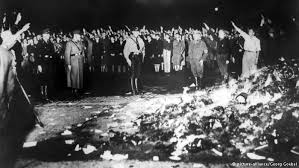
For much of my life, getting rid of a book was blasphemy. Books have always been sacred to me. As a young person, I was deeply affected by an image of books being burned by Nazis. Piles of books up in smoke. In my personal Ten downloadCommandments, One Must Not Destroy Books. We all know where that can lead.

There is a scene in the wonderfully cheesy disaster movie, The Day After Tomorrow, in which having taken shelter from a world-destroying storm in the New York Public Library, the characters begin to collect books they will burn to stay warm. One of the group objects and clings to a Gutenberg Bible, determined to save civday after tomorrowilization until another quips that there can be no harm in burning the multiple volumes of the tax code. The point is well made. Not all books have equal value.

Three years too late, I have come across this sensible and well-written piece about downsizing books by Summer Brennan called “On the Heartbreaking Difficulty of Getting Rid of Books.” It is based on Marie Kondo’s The Life-Changing Magic of Tidying Up. (Aside: I like to imagine Kondo’s books gathering dust on shelves everywhere, but that reveals something perverse in my nature.) What Brennan has done is apply Kondo’s now iconic zeal to her own life in a way that makes sense to her.

Brennan captures what’s wrong with any “one size fits all” approach to book culling. She writes, “It occurred to me that part of the reason why tackling the ‘books’ stage of the Full Kondo seems so daunting is that to many of us our books don’t really belong in the category she has assigned. They are not impersonal units of knowledge, interchangeable and replaceable, but rather receptacles for the moments of our lives, whose pages have sopped up morning hopes and late-night sorrows, carried in honeymoon suitcases or clutched to broken hearts.” Yes, that is it. The piece is well worth reading if you are about to embark on a book cull.  If you need further inspiration (and another book) go to the source material. Marie Kondo’s work has been much praised and mocked (a sure sign she is on to something) but I find there is something deeply consoling in her simple rule that one’s things should bring one joy.

Joy was the last thing on my mind when I moved from Calgary to Boston three years ago and faced the daunting task and considerable cost of moving fifty years of accumulated books. I cut my personal library in half. I never wanted to count how many books went. Too heartbreaking. I did it according to the space they took up. Each shelf was halved. I was methodical. For the most part, the Canadiana and hard to find books were boxed and went with me. Treasured gifts stayed. Books that brought me back to a specific time and place stayed. In short, books that had woven their way into the fabric of my life could not be given away. I worked hard to give my discards the possibility of a second life and keep them out of the landfill. If nothing else, I owed it to the trees.

Many of my Women’s Studies and feminist books went to two local women’s centres. That felt good. Except the ones I had to keep. Again, they were too much a part of me. I don’t even want to admit which books I ditched and which I kept for fear it will say too much about me. If I owned multiple books by one author, I would tell myself to keep only my very favourites. It was relatively easy to keep only two Dickens but then I kept every Carol Shields book. These were far too precious. I gave away Middlemarch, still unread since a Victorian Lit course in the 1980s.

Oh dear. I have revealed too much.

Of all the books I gave away three years (and two moves) ago, I have re-acquired only two. Oddly, one was Anne of Green Gables. Actually, I didn’t even have to buy it. A good friend, also moving, gave me one of her three copies. In the mean time, I have spared myself the cost of moving hundreds of books around (twice) and the cost of keeping a space to store them. Trust me, I still have a lot of books. For some reason, I feel it absolutely necessary to have six dictionaries.

Hard as it is to admit, you can have too much of a good thing. Even books.

History Wrapped in Art and Craft: The Hungry Grass by A. Mary Murphy

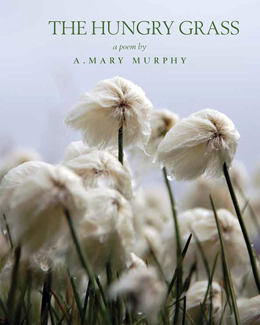
A. Mary Murphy’s The Hungry Grass is gorgeous. It sweeps me up with its vivid images. It has altered, forever, my ideas about the Irish potato famine and those who lived through it, died in it, or fled it. Gone are the dry, two sentence descriptions of faceless Irish I was given in school texts. Murphy has given me something so much better. She has given me history wrapped in art and craft. She has brought these people and their world to life. The Hungry Grass

The book length poem is 2295 lines, each with seven syllables. I don’t pretend to understand poets and what would possess a person to submit themselves to such a strict form; I only enjoy the incredible result. Murphy mixes Irish dialect with English and seamlessly embeds meticulously researched details into the work which describes fifteen years in the lives of her ancestors. In the first pages, we see the life of Irish Tenant families before the famine, carried through each season with its particularities, its work, its religious observances, and its customs until a full year passes. Life before the famine is hardscrabble but it is also full of joy. The narrator marries in the spring and by the next spring, gives birth to a child, her little life so precarious and precious. The reader knows what the stakes are here. Love is love, whether it is in 1834 or 2016. And so is hunger.

Although the details place us firmly in the Irish potato famine, the poem’s richness cannot help but tie it thematically to all famines, all mass migrations, all displacements, all droughts, and all victims of soulless and intransigent governments.

The poem starts, “And it is how it happened / before fields of hungry grass / grew up over all the world / pinching us with starvation” and I am hooked. “Pinching” is such an excellent verb to attach to “starvation.” I feel it in my body, in my stomach. I read on and am shown the thousand-year churchyard, the neeps and nettles, the furrows in the soil ready for planting, the Liecester rams, cormorants, perch and corncrakes crying in the meadow and even a trespassing goose. I am fully immersed in this world of the past and given a close up view as it falls apart.

I was fortunate to hear Murphy read from this book last week at an Inanna Publications event at Owl’s Nest Books in Calgary. Hearing her read, hearing the lilt of the Irish, and experiencing the flow of the language coming seven syllables at a time was a delight. Murphy makes use of all the senses to put us in this time and place. I hear the birds and feel the breeze. I am, like Murphy was during her research, in the bog. And I am hungry.

Thank you for this book, A. Mary Murphy. This is art.

Cancer is Not a Journey

Cancer is not a journey. Stop with the meaningless platitudes.

Cancer is a kidnapping. A hijacking. You’re going along, living your life and BAM. A bag gets thrown over your head and you are captured and you don’t know where the hell you are going. Or you are at gunpoint, being forced to drive by someone who won’t tell you the destination or how long it will take and you’re trying not to piss yourself. Or you have been thrown out on the side of a desolate highway with no water, no food and no map. You watch the car disappear in the distance. You might die of thirst. You might die.

A random bunch of rogue cells has taken over your body against your will disrupting everything you thought you knew about how your body works and who you are. Then it forces you to go places you don’t want to be. Like chemo. In the chemo room, you try to pretend it’s normal for fluorescent poisons to drip into your arm. You learn a language that you don’t want to learn and can only really speak among other people similarly kidnapped. It’s not like going to Spain and getting to try out a few phrases from the phrasebook you bought in the airport. There are no tapas. It’s not fun. You don’t get to feel more sophisticated and cosmopolitan because of it. Just tired. And terrified. You sit in a room with other tired and terrified people who have their own fluorescent poisons dripping into them and are desperately trying to learn this language and you smile instead of scream because it’s not their fault you are there, so what’s the point of screaming? Cancer doesn’t hear you scream. It doesn’t give a fuck. It’s a fucking sociopath. Sometimes it cuts off a breast just to make a point.

You’ve been kidnapped. Your sweat has a new smell. The smell of fear. Everything tastes like metal and who cares because you can’t keep it down anyway. You are grateful when you vomit and taste bile because it means your body actually might have absorbed some food before it rejected it. You hardly sleep and when you wake up, you wake up to the realization that you have cancer. Every damn morning. Several times a night. After every nap.

You try to think of a plan to get out. There must be a way. You’ll try anything. The hucksters and charlatans come calling offering you snake oil and herbs and magic pills and you will do anything, pay anything, to be freed from this captivity. You have learned the meaning of desperate. You cry. Often. Sometimes with other people. Sometimes alone.

Cancer hijacks your body and it hijacks your voice. There isn’t a person on earth who would want to go where cancer takes them. So stop trying to make it sound like it has purpose and meaning by giving it an archetype and calling it a journey and saying those in the middle of it are brave. It’s a fucking hijacking. People who have cancer are in the middle of trauma. They are scared. They are by turns angry and in denial and grieving.

Some people don’t make it out alive. The hijacker, all hopped up on their power trip, kills them, and there will never be any justice. That’s what cancer is.

Those who live do not come away unscathed from this calamity. Every single one of them has had to face their own death. It’s not pretty. It’s not a waterfall in Hawaii. No one takes a selfie. People who have cancer have to imagine the lives of their children without them. They have to come to grips with losing everything. Some have gone broke paying the ransom. Some have PTSD.

Calling this kidnapping, this hijacking, a journey is gaslighting. Stop it. Call it what it is. Appreciate the enormity of what people with cancer unwillingly face. Of what I’ve faced. I wasn’t on a fucking journey. I was clawing my way back to life from a cave I got thrown into against my will. I have friends in the cave now. Just do me a favour and stop calling what they are facing a journey.