Author Archives: Jane Cawthorne

About Jane Cawthorne

Jane is a writer currently living in Victoria BC. She grew up in Toronto and also spent many years in Calgary where, among other things, she taught Women's Studies at Mount Royal College (now Mount Royal University). Her work is about women on the brink of transformation.

The Importance of Feminist Writing and Feminist Presses

My colleague and sister-in-spirit, Elaine Morin, just pointed out a great interview about Inanna Press in Booknet Canada that highlights one of our co-edited anthologies, Writing Menopause. It’s a delightful endorsement of our work from the Assistant Publisher, Evelyn Elgie. (I almost said “new” assistant editor, but she’s been there almost a year now.)

She says:

“So, the community of older women that I see at Inanna is really, really powerful of women who are writing on all sorts of different aspects of society. The different things that are important to older women that we often don’t talk about that can maybe be taboo. For instance, we have a book called “Writing Menopause,” which is an anthology. I have taken it to every market that I’ve done, every sort of tabling opportunity since I’ve been at Inanna. I took it to the National Women’s Studies Association Conference last weekend in Puerto Rico. And what I consistently see is that it gets a ton of attention. There’s not a lot of work on women’s experience of menopause.“

Sure, it should come as no surprise that the Assistant Publisher of our own press might endorse our book. But what really pleases me is that she pulled it out of the way back catalogue to highlight it and that says she takes it with her to every conference. She highlights the importance of it and its continued relevance to readers. It remains the only book of it’s kind. Not bad for a book that is almost a decade old in a world where books can take years to get published and forgotten in weeks. I’m proud to have produced something that lasted. I think I can speak for Elaine on that point too. And I’m still so proud of all of our contributors who wrote so fearlessly.

If you’re curious about feminist publishing or already care about it, I encourage you to listen to or read the whole podcast. It’s worth your time.

Ten Million People in Tehran

The narcissist in chief, the maniacal MAGA man, and certainly one of the top 25 WORST humans on the planet, has threatened nuclear war. Hinted at it. Suggested it is one of the available options. A tool in the tool kit. In his ill-conceived and illegal war he can’t win because no one knows what winning even means. No one knows the goal. (Whispers: We all know the goal.) And this deadline is in about (checks time) an hour.

It’s hard to think about anything else. The sun is shining, I hear the laundry tumbling downstairs, birds are chirping outside, there is a slight wind, my neighbour is out with his whipper-snipper, and dinner must be made soon. Everyone has to eat after all. Everyone has to eat. Everyone.

But there are about 10,000,000 people in Tehran facing annihilation. I think about the people, mostly women, trying to make sure everyone eats. I don’t know if there are actually any words for this moment. I’m not so much a praying person, but maybe that is what I’m doing.

Working?

How is it possible to work right now, to think, to have the concentration to write things down, to do whatever it is we are expected to do in the course of these days and weeks, in the midst of climate collapse, war, genocide, and all the rest? The tough personal stuff, the tough world stuff. But it has always been like this. Always.

So get out there, find some joy to sustain you, take breaks when you need to, and continue your work, whatever it is. Know that I am trying too.

Also, dear subscribers, my subscription notices have not been working. Speaking of working. So look back, maybe read my memory of Stephen Lewis and catch up on whatever you like. I’m hoping this reaches you.

Stephen Lewis. A Great Canadian, a Moral Compass

On the passing of Stephen Lewis, I want to tell a Stephen Lewis story.

Stephen Lewis at Calgary Public Library event. I can’t remember the date

Stephen Lewis at Calgary Public Library event

On left, me. On right, Stephen Lewis. Middle, my friend Colleen.

Me, my friend Colleen, and Stephen Lewis.

I am fortunate to have met Stephen Lewis many times. One of these times was when I lived in Calgary and attended an event at which Stephen Lewis was speaking. I saw him speak whenever I could. I have always thought of him as Canada’s moral compass. There was a little meet-and-greet before one particular event, and there I was watching people meeting and greeting this wonderful man. I couldn’t help but notice people seemed to demand so much of his time and energy. He looked tired.

A day or two before, I had been interviewing Dr. Helen Caldicott, the Australian physician, author, and anti-nuclear crusader. She demanded to know if I had read Naomi Klein (Stephen Lewis’s daughter-in-law) and I assured her I had. Dr. Caldicott went on to sing Naomi Klein’s praises and explain to me why Naomi Klein was right about everything and a bright light for all of us to follow. We bonded over our mutual admiration.

When my opportunity to talk with Stephen Lewis came, I did not want to be a drain on his energy, so I told him about this conversation and he instantly lit up to echo the praise of his daughter-in-law. From there, he went on to tell me, in the most animated fashion and with the most incredible vocabulary, about the rest of the family. Whatever other wonderful things Stephen Lewis was, he was, first and foremost, a family man.

I was so glad to be able to give him something, this man who had given so much to so many. He went on stage looking sprightly.

Now, years later, I’m a member of one of the many grandmother groups that are part of the Stephen Lewis Foundation’s work. We raise money for our sisters in Africa who are trying to keep their families and communities together throughout the HIV/AIDS crisis and more. I only joined this group about three years ago, but I am so glad to be part of this important work and part of Stephen Lewis’s legacy.

If you would like to honour him, consider making a donation to the foundation. They do great work.

May Stephen Lewis rest in peace and power. May his memory be a blessing to his family and all of those who love him. May his deeds inspire all of us to be better.

(These photos are not from the same event I’m describing—they are from a Calgary Public Library event. But these are the only photos I could find of me meeting Stephen Lewis, so here they are!)

Six Years and Counting

March 13, 2020.

My husband and I decided to walk downtown to go see his parents. A long walk, but a nice one. We visited for a couple of hours. I can’t remember if we had tea or just did the usual technology problem-solving that had become a regular part of any visit. When we started the trek back home, it seemed pretty quiet for downtown Toronto. Hungry, we stopped in at Kinton Ramen on Bloor. When we got there, it was almost empty. Unheard of. There were the two of us sitting by the front window and another group of four in the back at a high top. The staff looked freaked out. We looked at each other and ate our ramen. I knew this would be the last time we were in a restaurant for a while. I’m sure the others in the restaurant knew too. By the next day (I think), they were shut down. We hopped on the subway after lunch, feeling the urge to get home quickly. There were about three other people on the same subway car. Ominous. On the short walk home from the station, we acknowledged that this was the last day we would have of going into restaurants and using the subway and… who knew what? Our lives changed just like that. Like Joan Didion says, “Life changes in the instant.” That was the instant.

I, unfortunately, already had lots of practice at isolation. Regular readers of this blog and anyone who follows my work knows I had a car accident in 2016 that left me badly concussed. I was unable to read, write, think too much, deal with light or loud noise or too much of anything. I had been working hard to heal and was making some limited progress. But I have to admit that at first, the slow pace of lockdown life was simply a relief to me. I didn’t have to say no to doing social things. I wasn’t missing anything. It was quiet. There was little traffic. For a long time, restaurants had been too loud and I would wear ear plugs if I went to one. Now I couldn’t go. The choice was taken away from me. Same for movies, concerts and everything else that was part of regular life. So, strangely, I was at an advantage at the start.

One person close to me called on March 15, panicked and crying. She said, “How are we supposed to do this? I can’t do this!” and I thought, “Welcome to the world I’ve been living in for four years.” I didn’t say that. Instead, I made a few suggestions on how to cope. However, panic was her preferred response, as it was for many people. I thought back to the start of my concussion and realized it had been for me too. But I had to panic very quietly. Everyone just needed some time. Occasionally, someone would ask me why I was so calm and I would remind them it was because I was already living a very contained life.

I remembered the first SARS. My friend’s father was dying and she was not allowed to go to the hospital to see him. It was serious. It was airborne. Toronto was in a panic. I knew this new SARS was airborne too (how could it not be?), but even I shied away from the implications at first. I still believed in public health. I followed their advice. I washed my hands and wiped down my groceries. That feels like eons ago. I remember an outcry from people who resented being told to wash their hands. I was absolutely astounded by this. Who doesn’t wash their hands, I wondered? I could not imagine what else people would be unwilling to do for themselves and for each other. Anyway, I assumed that there was a mask shortage and that was why the powers that be were not advising masking as a general practice for everyone. They made unintelligible distinctions between aerosols and other particles and whatever and it was all nonsense. I wished they would have just been honest about it, admit there was a shortage and ask people to leave supplies for health care workers first. But that was a dream world. Look at what had happened with toilet paper. Masks would have been hoarded the same way.

What I remember most about this time is how Public Health and other authorities muddied the message. The message never got clear again. How hard would it have been to explain harm reduction? The precautionary principle? The need to ramp up production of PPE?

I didn’t want to take medical supplies away from those who desperately needed them, health care workers or other workers who had no choice but to be in close proximity to others, so I started sewing. I gathered every scrap of fabric I could find, raided my craft supplies, found some elastic and got busy. First I made two layer cloth masks, then three, then four, at which point my sewing machine could barely get through the layers. I gave them to everyone I knew, to anyone who wanted them. It was something I could do to help, and I did it. I ran out of elastic. Eventually I found a small craft store that was packing orders for people and offering door stop pick up. With my elastic supply replete again, I kept sewing. Once masks were plentiful again, and no one on the “front lines” was going to run short, I started using N95s. Cloth masks are better than nothing, but not the best. I wore N95s all the time indoors in public. I’ve never stopped.

In the beginning, I wondered when I would see my daughter again. In a way, I was lucky. She was working “in the field” as an engineer and had to travel to Northern Ontario regularly. This travel and living in large work camps was incredibly stressful for her. The risks of getting covid were huge. On her way to and from home, she would stay in Toronto a few extra hours or an extra day. We would sit in the freezing cold together in the garage with the door open, masks on. That’s how we had Christmas in 2020. We called it, “The Saddest Christmas Ever.”

Toronto was different than other parts of Canada. Lockdown lasted a long time. Everything except truly essential services were closed. We couldn’t get a haircut. Such a minor inconvenience, but an example. Businesses were in crisis. For months. Rural people had the luxury of space. We did not. So much of what the rest of the country depended on came from big urban centres like Toronto. Those Amazon deliveries were starting from warehouses with masked workers in Toronto. Essential workers. Workers who kept us all going. Workers who had to get to and from home. Everyone breathing. There was a positive sense of everyone doing their part. We went outside and banged pots for health care workers. But people are impatient. It went on too long. The implications of what we were learning (that we actually COULD support each other, that temporary benefits actually COULD be extended into a UBI type program, that less traffic meant cleaner air and a healthier environment, that there were new, technology driven ways to increase inclusivity and so on) would impact everything about public policy. Some people didn’t want that. Most people I guess. It would be expensive, they said, not understanding what might be gained. Getting “back to normal” remained a goal, even though normal was so far back in the rearview mirror it was barely a speck. We were just beginning to understand the long term implications of Covid, of Long Covid, that Covid is a vascular disease that presents as a respiratory disease and continues to do damage long after the cold symptoms are gone. We knew almost right away it affected the heart and the brain. I had already done so much to heal my brain. I did not want to start over.

It wasn’t all bad. I remember on the second day meeting friends outside by Lake Ontario and all of us being completely amazed at the silence, at the clarity of the sky. No planes. No traffic. I had a 4km walk I did almost daily which took me through the Humber River Valley and to Lake Ontario. Animals were coming back. There were so many birds. One day, I encountered a ten point buck. A miracle.

We had such hope when vaccines came.

I don’t have the heart to continue. It is just too sad.

The pandemic changed our lives. My husband found the most enjoyable parts of his job were gone and retired. Early. We were lucky we could do that. People died. Public Health died. We got vaccinated. We left Toronto and came out west. More space. Fewer people. Easier. At least it was for a while. Until Omicron. The variant of variants. The variant that should have demonstrated once and for all why continuing to get and give Covid over and over was a terrible idea. But humans, man. We never learn.

There is chatter about the development of a sterilizing nasal vaccine. Maybe five years away. Imagine if the amount of money that just went into killing a bunch of folks in the Middle East had been dedicated to vaccines, or even to cleaning the air. Imagine.

Spring Cleaning In My Office

I’m feeling better and getting back to work!

For me, a new project starts with cleaning up. Out with the old! Make room for the new!

My office has been an utter disaster. Two years (plus) of illness has meant that not much work has been done. Goddess-knows-what has been piling up on my desk, and those piles have fallen over and merged into each other. At various times, my office has become my bedroom, the only place which could accommodate a hospital bed and all the other accoutrements of illness.

It has been chaotic in every way and no part of my home shows that chaos like my office.

Not anymore!

It’s finally happening. I’m feeling good. I’m cleaning up. I’m down to two medium piles of as-yet-to-be-excavated paper on my desk, and I believe neither of these include medical records. All of those are filed now. And all hints of my dark times are gone. (Well, there IS a requisition for a lab test on one corner of my desk, but there will always be something!) I believe I am about to find my novel in progress and notes towards a book of essays.

I have cleaned the closet that got stuffed with stuff when we moved in. It is organized. I know what’s in there now. With all the clean up, I even found a home for the Emergency Go Bags. They don’t have to live under my desk anymore! It all feels good.

Some bonus work: I also sorted out and found homes for all of my sewing, knitting, crochet, and other crafts. I even put all of my patterns into a binder. This is extreme organization for me!

Now I’m going through my book shelves. I’ve just given away 20 or so books about writing to a local writers group–not because I’m done with writing but because I’m done with those books! I regained a whole shelf and that has become a dedicated poetry shelf. And I’m reorganizing the rest of my books in a way that meet the needs of the coming writing projects better.

And as I do so I’m reading. READING! Reading deeply. I’m able to concentrate. I’ve found my old ongoing annotated bibliography and I’m using it again, not worrying about the break. I just started a 2026 section and am going for it.

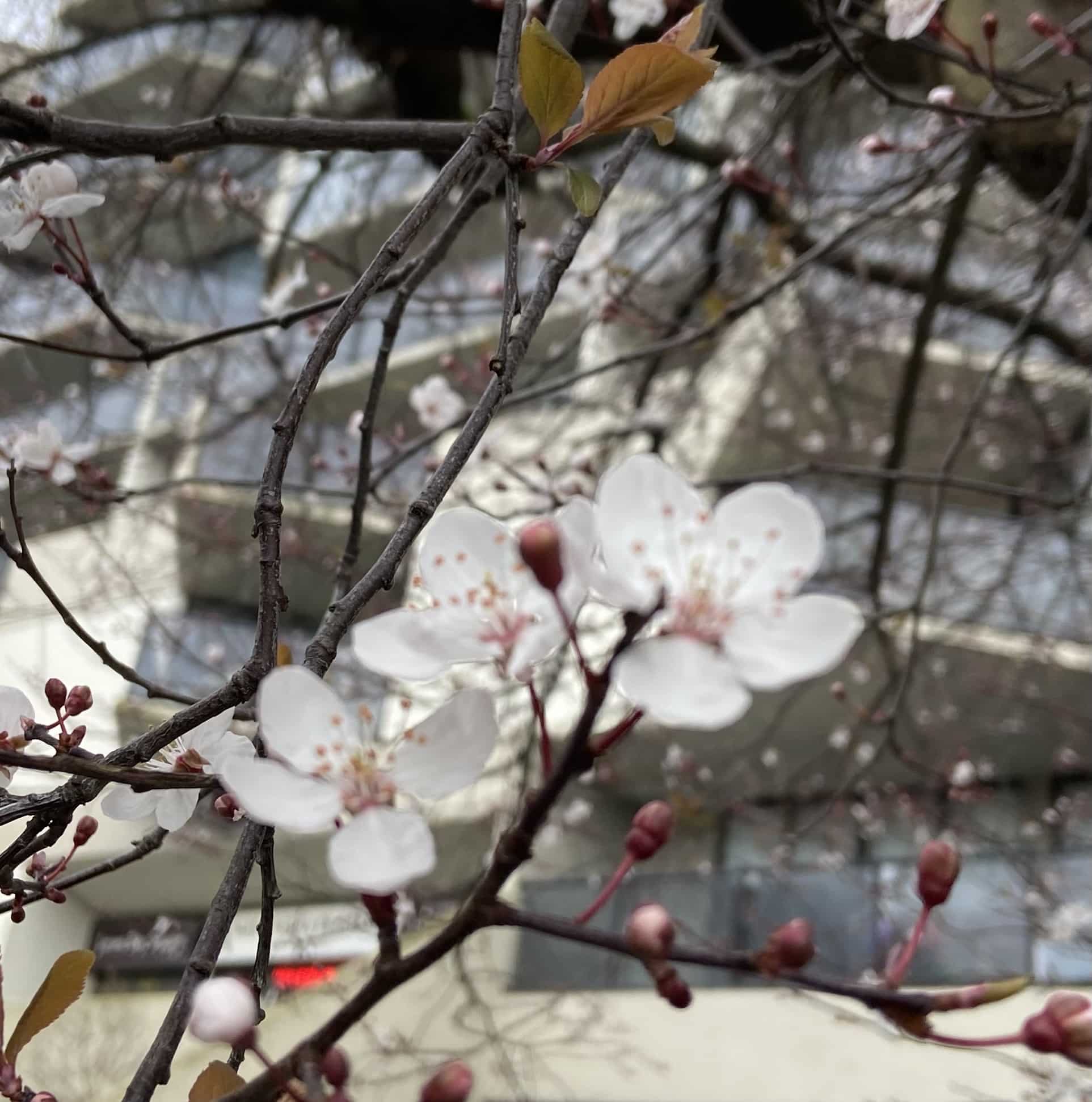
It’s not too early for spring cleaning–the cherry blossoms are coming out here–and that is where I am. Springing back to my working life.

Yay!

Cherry Blossoms

The first cherry blossoms in the neighbourhood