My own personal Chernobyl

A long time ago, I thought of writing an essay about radiation. That was prior to my first cancer diagnosis, (Hodgkins Lymphoma) and prior to receiving radiation therapy which, at first, saved my life and is now killing me. It’s not really fair to say radiation snuck up on me; I have always been aware of it.

Although I was not part of the generation that had to practice “duck and cover” in case of nuclear war, I was a kid who thought a lot about radiation. I knew too much about what time it was on the Doomsday Clock. The Three Mile Island nuclear disaster happened in 1979 when I was sixteen years old, and it haunted me. I wondered how far the fallout would spread, how it might change with the wind. Harrisburg, Pennsylvania was about 315 miles from Toronto, as the crow flies. I went to the Atlas in my classroom with a ruler and figured it out. I wondered where the other nuclear reactors were. I saw photos of people after Hiroshima, their skin falling off in ribbons. In 1982, like so many others, I saw the film, “If You Love This Planet,” a plea by Dr. Helen Caldicott to end the insanity of the arms race and nuclear proliferation. I don’t know how many times I have thought of the movie “Silkwood” since I first saw it. Then, Chernobyl happened in 1986.

In the 90’s, I got the opportunity to interview Helen Caldicott for a small local newspaper. She was visiting Alberta to oppose efforts to build a nuclear power plant in Peace country which, rather inconveniently, sits on fault lines. It seemed like a bad idea to me. Caldicott was brilliant and inspiring.

That was when I first thought of the radiation essay. I wondered what my own personal exposure to radiation had been. Could a person somehow tally up their dental x-rays and other x-rays, their exposure to all kinds of environmental radiation and know anything valuable? I realized soon enough I did not have the scientific knowledge I needed to write such an essay and dropped it. Dr. Ursula Franklin and others had brilliantly proven that nuclear tests were leaving their trace in humans, finding strontium-90 in the baby teeth that mothers had saved. Other much more knowledgeable people were on it.

Years later, one of my few “viral” moments on social media occurred after being awakened by a public alert about a situation at the Pickering Nuclear Plant which sits on the shore of Lake Ontario. I can’t remember exactly what happened anymore (or more likely, what almost happened). I posted something in the darkness about how it seemed a lot people had just been reminded that there’s a huge and aging nuclear power plant on one of the largest bodies of fresh water in the world. A literal wake-up call.

I had been to a protest at the Pickering plant before with a group of Raging Grannies who were opposed to efforts to continue its operation past its best-before date. There was a meeting of fat cats and regulators going on that day and the Grannies tried to get in. We were not successful. I had to de-escalate a situation which may very well have resulted in the arrest of one of my compatriots who was well into her 80’s at the time. I saw first-hand how opposition would not be tolerated. They were scared of a frail 80 year old. Take from that what you will.

Somewhere between Helen Caldicott and Pickering came the radiation therapy that helped to save my life. I remember being nervous about them radiating my heart. I wondered how it would affect me both literally and metaphorically. I couldn’t have asked my doctors such a question. There are some things you just keep to yourself. But now I know the answer.

And now I also know, finally, what the radiation essay is really about. It’s not an essay I would have needed a big background in science to write. It’s about me and my own personal Chernobyl. It’s about how I will die.

I likely will never write it. I don’t want to spend my time right now alone and writing, especially about my own death. But maybe you can imagine I wrote it. Maybe this IS the essay.

The damage in my body from radiation will never heal. It will continue. Radiation has a half life. It keeps working. It will keep doing its damage until that damage can’t be fixed anymore. I try to be sanguine about my situation. I see no other route that allows me to carry on.

Very recently, a doctor was looking at my file, shaking his head. He told me in an offhand way that radiation therapy of the mediastinum is no longer part of the treatment for Hodgkins Lymphoma. It isn’t necessary. The doctor added that no one follows up on patients who had radiation when it was the standard of care. People like me.

And how could they follow up? Who would do that work? How would they track us down? I’ve moved five times since then, including to two other provinces and even to another country.  Although it sounds like follow up would be a good idea, it’s not practical. They can hardly issue a recall on a cancer treatment. Or can they?

But I digress. The real point of this information is that radiation therapy didn’t help me. It didn’t save my life after all. There is no justification. But who knew? At the time, it was the standard of care. At the time, I would have done whatever they said needed to be done. I had an eleven year old.

The tally of it has been dizzying. A lifetime of thyroid treatment, two open heart surgeries, a third open chest surgery, another open chest surgery to remove part of a lung. And now I’m waiting on another heart procedure which, fingers crossed, might repair another valve.

I try to retain some sanguinity. I realize that there is no part of the word “sanguinity” that means “relaxed,” but the word sanguine itself seems relaxed. It’s the “s” sound, the way the word feels loose when spoken. The sounds are soft, and I have to stay soft. So I’ll write an essay about not writing an essay. So much easier.
Too hard to talk about

I’m trying not to go dark, that is, to stop communicating. Most people I know understand (I think) that if I’ve gone dark, something is up. It’s too hard to talk about. So I’ll talk around it.

In this moment, I feel foolish. I believed. And I worked so hard.

The thing is, every new problem, every new cut takes something from me. I recover, sort of, but never to where I was.

I feel foolish because I thought I had learned to accept non-recovery a long time ago. After the first cancer. After the brain injury. I knew I would never be the same, but I forged ahead anyway.

And now, again, just when I start to let go of the worry, the next problem arises. It’s just like last August.

Little did I know last August, riding my bike in a state of total happiness, that I would never feel that good again. There were more cuts coming.

Fool me once, fool me twice, fool me three times, four times, five times…surely I am the fool now.

And now I wonder: is this, today, the crest of another wave? Is this as good as it’s going to get this time? This wave is much lower than the last one. Sometime, much sooner than I had hoped, the waves will barely be ripples.

Do me a favour—don’t ask me about it. Just know it’s happening, and I will know that you know, and that will be fine.

PS. A couple of hours post posting and I want to add that if this is as good as it’s going to get, I’m going to squeeze everything I can out of this day.

No Time to Be Timid

We are bombarded by bad news, but we haven’t even grasped the half of it. This blog of mine can’t be a place for constant doom, but it can be a place for encouragement. Today’s theme: There’s no time to be timid. Get out there and fight the fascism! You can do it!

Those of you who have been with me for a while know that I don’t do denial. Fascism and authoritarianism are spreading worldwide. The US has fallen and Canada will be next if we don’t face reality. Empower yourself to act.

Here is a task: speak to someone about the situation. I’m sure they are worried too. Speak to more than one person. Decide what you will do. Everyone can do something. Here is a nice list of 30 lonely actions anyone can take. Choose one. It doesn’t have to be the best one or the right one. Just choose one and see it through. You’ve already done one—you spoke to someone about your worries. You’ve already started.

There is an old saying, “Nothing succeeds like success.” Doing one thing will encourage you to do it again or to choose another. Talk to another person. See if they want to do something else too.

It’s only fair to tell you what I am doing. Well, a lot I think, particularly when I realize I’m 9 weeks out of open heart surgery and what was the worst year of my life. I wrote a dozen or so letters from the hospital in the two or three days after I left the ICU last time. I’ve written a dozen or more since. They go into a “political action” file I keep. It makes me happy. I don’t get discouraged if no one answers. I keep writing. I will not be silent because silence is complicity.

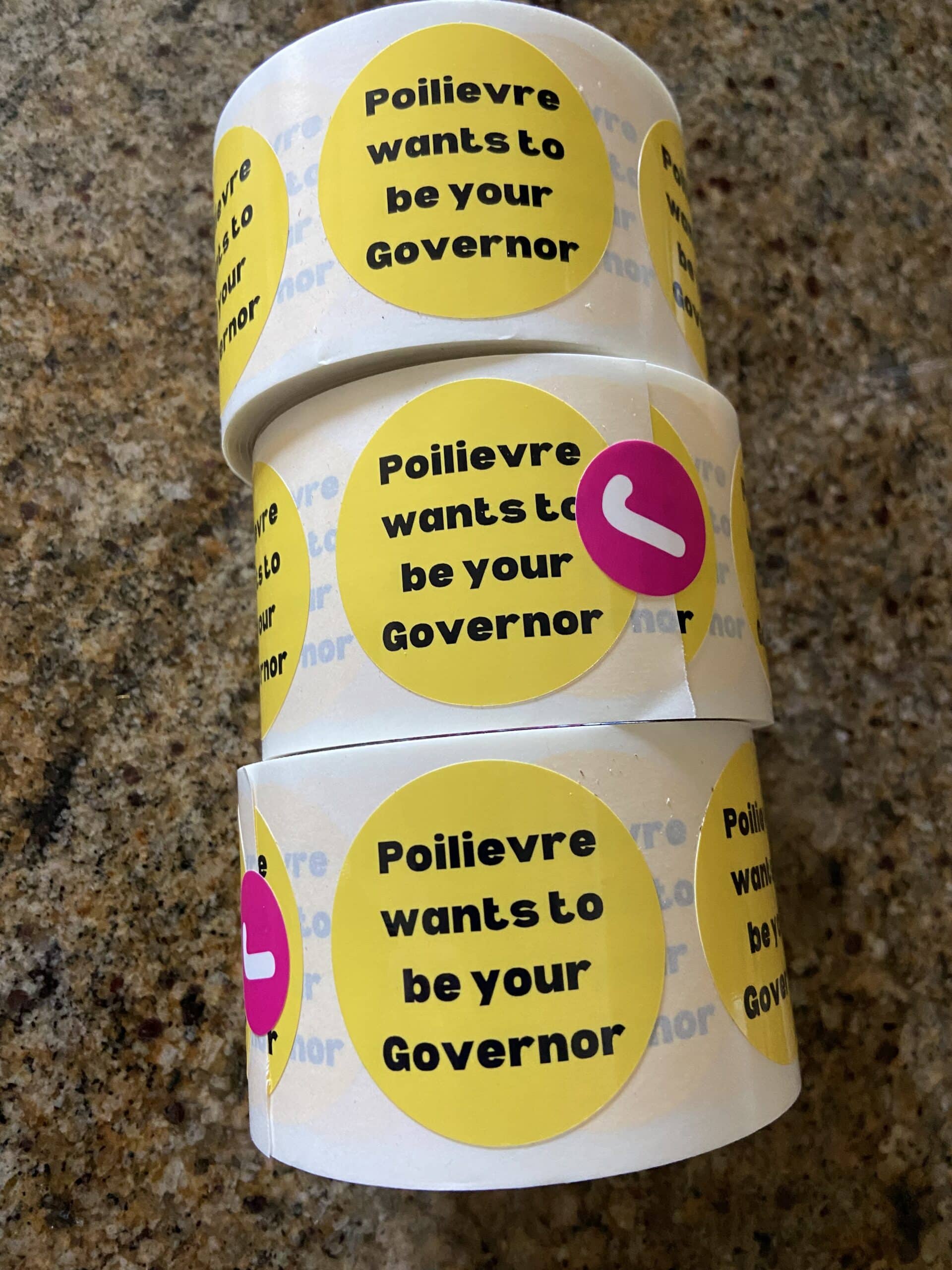
And while I’m still getting back on my feet, when I’m walking, I’m stickering.

Three rolls of stickers that say “Poilievre Wants to be your Governor” in black writing on a yellow background.

Stick with it


Where did I get them? I had them made at a local printing company. They deliver. It’s not that hard. And I get a moment of glee every time I stick one somewhere. I have other stickers too—I’m thinking of printing ones that say “Bankers not Wankers.” What do you think?

Next it will be delivering flyers to mailboxes. You don’t have to invent or reinvent the wheel here. 350.org has a lot of posters prepared in the “Don’t Get Played” campaign. Print some. Go for a walk, put them in mailboxes. Sit at a picnic table in a park with a sign that reads, “Election Conversation?” In my experience, people want to talk. Hand flyers out on a street corner. Go with a friend. You can do it. If someone is rude to you, tell them to have a nice day and move on.

Don’t do what the US did. Don’t sleepwalk into fascism. Face the fascism and do something about it. Don’t be timid. You CAN do it. I believe in you.

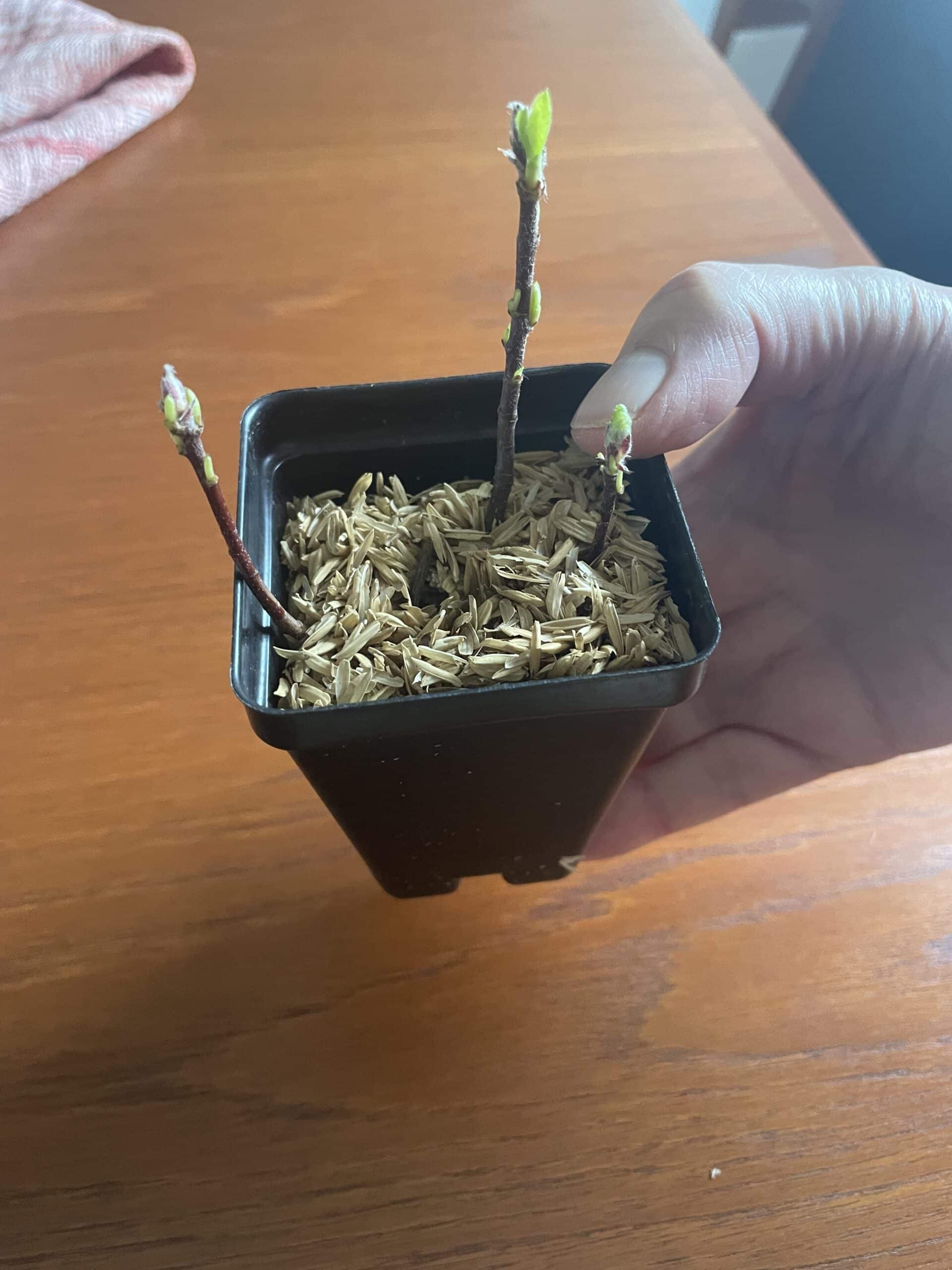
And in case you think I’m a Doomer, I’m planting the tiniest Saskatoon Bush ever. Because that’s another thing I’m doing—finding JOY when there is joy to be had. I believe in joy. And I’m going to believe that one day, I’ll get a berry from this tiny thing. I believe I will live in Canada, a free, sovereign country, and I will eat Saskatoons grown in my garden.

The tiniest Saskatoon Berry bush ever.

Optimism

Arc of Recovery

I keep seeing my health disaster as a metaphor for the global disaster. Or maybe it’s the other way around. The global troubles mirror my own. As I recover, I keep trying to impose a recovery metaphor on the bigger world too. It might all be wishful thinking.

I would like my recovery to be orderly. I want predicable progress towards something more like who I used to be. This mirrors my desire to have an orderly recovery from whatever [waves arms frantically in all directions] all of this is. The world order is upside down. As Prime Minister Trudeau said, “Make that make sense.” We can’t.

Recovery, for me and for all of us, will not be smooth.

I’m not expecting to get back to normal. Whatever that is. Whatever that was. Normal is an illusion, an ever-shifting sand dune, nostalgia. We live in the present and the present is full of surprises. I just want to get little better than I am now.

Recently, I’ve been thinking about my long held belief in Dr. King’s notion that the arc of the moral universe is long and bends towards justice. Most of my life, I’ve had a beautiful graph in my head, a mostly smooth arc, rising (admittedly not as fast as I’d like) towards a just society.

Of course that’s nonsense. The arc of that graph is far from smooth. Ask anyone being lynched. Ask a refugee facing years of displacement and heartless bureaucracy. Ask someone who doesn’t have clean water. Ask someone who has been colonized. Ask a mother whose child was killed by the police, knee on his throat, unable to breathe. Ask school children who have been shot. Ask those with bombs dropping on them. I could go on and on. Get too mired in the details, and that arc in the graph starts to look pretty jagged and might even be heading downwards.

In 2018, Mychal Denzel Smith wrote about the context for Dr. King’s famously hopeful characterization of history. According to Smith, King’s “use of the quote is best understood by considering his source material. ‘The arc of the moral universe is long, but it bends toward justice’ is King’s clever paraphrasing of a portion of a sermon delivered in 1853 by the abolitionist minister Theodore Parker.” King abbreviated Parker, who said, “I do not pretend to understand the moral universe. The arc is a long one. My eye reaches but little ways. I cannot calculate the curve and complete the figure by experience of sight. I can divine it by conscience. And from what I see I am sure it bends toward justice.” This is a statement of hope, of faith, not of fact.

Oh, how I wish it was fact. Again, too bad for me. Too bad for all of us. Wishing something is going to be doesn’t make it so.

A dear friend of mine looks adversity in the eye and says, “Onwards!” I hear her voice at times like this. “Onwards!” Time only moves forward. Maybe there’s a simpler way to look at recovery. Cicero said, “Where there is life, there is hope.” I can stick with that for now.

Five signed copies of Patterson House to give away

(Hi everyone! Thanks for helping me celebrate. The books are gone to five fabulous readers.)

Who doesn’t like free books?

I’m delighted to let you know that my publisher, Inanna, has been taken over by Radiant Press. This means that my two books with Inanna will live on! They will not go out of print. What better way to celebrate than a book give-away?

To celebrate, I offer a free, signed copy of Patterson House to the first five commenters on this post who offer me a Canadian shipping address.

I hope you enjoy Patterson House and I’m so pleased it will continue to be available to readers. Thanks for all the hard work by Inanna and Radiant Press!

Elusive Sleep and Disrupted Time

Anyone would say I’m doing well. I’m healing, thank the great goddess. But. It’s hard work and by 7pm, I need to lie down. Sometimes that happens before 7pm. The nights are long in recovery. Much as I yearn for sleep, a little unconsciousness, a brief vacation from pain, I don’t sleep.

I have trouble falling asleep, thanks to a combination of pain and a new mechanical valve that ticks. I’m trying to get used to the sound, but at present it is like a dripping tap. It keeps some part of my brain in a state of wakefulness and watchfulness. Will it tick again? Yes. Always. It will still tick after I die. It’s fast. More like a loud clock than a dripping tap. It should be consoling; it is proof of a working valve. I meditate on making it my friend, my reminder that everything works now. This will take time.

When I fall asleep, it is not for long. Shifting my position means waking up. I’m up every hour, uncomfortable, and think, “How can it possibly be only 11:30?” Or 1:30. Or 4:30. But that is the time and there is more night to get through. Sleeping, like everything, feels like work. This is a hard truth of recovery. Instead, I would like the night to have 6 or 7 hours of blessed oblivion. If only. Instead, I get a series of short naps. If I’m lucky.

This probably sounds familiar in some way to many folks. Our sleep is off. I know this because there exists a booming industry dedicated to helping us sleep. From pills to podcasts, there are a lot of people ready to use capitalism to help me sleep. Sleep hygiene is a big thing. Meditation apps have whole sections about sleep.

We can’t sleep.

I once read an article that our practice of sleeping in one long block of time is a new construct. In pre-capitalist times, people had two sleeps—-the big sleep and the little sleep. In between, they would get up, look around the cave or the farm, stoke the fire, check the animals, have sex, snack. When capitalism took hold, the factory owners wanted people more productive and made their nights shorter by saying 8 hours of sleep in a row was the right way to sleep. Right for who? It didn’t take long for millennia of natural sleep patterns to be disrupted forever. But I sense that if left to our own devices, (and if we turned off our devices) many of us might go back to a big sleep and a little sleep. My broken sleep might be a good thing. It might be anti-capitalist. I like that idea.

Related to my poor sleep is my poor sense of time. Since my brain injury in 2016, I’ve struggled. Now I’ve had four general anaesthetics in under a year. That’s hard on anyone’s brain. I simply don’t follow time anymore. Don’t ask me the schedule. I don’t know. I cannot know. I use ALL the tools. Calendars, reminders, alarms. Those devices that plague our sleep have their uses. And I have my husband reminding me too. I’m lucky.

However, like my inability to sleep, I don’t think my inability to track time is just a “me problem” anymore. I sense that our collective perception of time has gone off. How can we possibly have lived through five YEARS of the pandemic? (Some find it easier to just pretend it’s over. Maybe denial helps them sleep.) How can it possibly be less than a month since the global order fell apart? (That is what has happened.) How can I have gone into the hospital in an era when the United States was an ally, and come out when it was a threat? Too much happens in a week, a day, an hour. Tick. Tick. Tick. It’s constant. It will continue after I’m dead. Exhaustion has taken hold and even sleep doesn’t seem to help.

To wake up tired is an awful thing.

Best to stay focussed on recovery, to let these ramblings belong to the night, and give the day to the little things we can do to get better and to take what action we can to keep our communities strong. Something to plan while I’m not sleeping. It’s 5:36. Maybe I can get another half hour of sleep.