Writing from Scratch

Just as someone who loves good food might yearn to cook, my deep love of books has burgeoned into a need to make them. At first, I thought that meant I had to create books from scratch. I like this analogy. Writing starts with scratches, a few tentative pencil marks, a word or six and it grows from there. That’s how my notion to write a novel started. I’m not finished it yet, but while I’ve been at it, I’ve created a couple of other books not quite from scratch and I’m finding this work equally satisfying. I don’t have to can the tomatoes (or grow them) to make a good sauce. If what I love is creating books, editing is as satisfying a way to get there as writing. It’s not starting from scratch but maybe that’s why I enjoy it so much.

I’ve always joked that I’m a re-writer more than I am a writer. Scratching those first words onto the page never comes easily to me, but crafting them afterwards is a joy. I recently had the wonderful experience of editing the work of over fifty other writers for an anthology I created with my friend and colleague E.D. Morin. It’s called Writing Menopause and it’s been picked up by Inanna Publications who plan to bring it out in Spring, 2017. The book is a literary anthology and the variety and high quality of work that writers submitted was inspirational. As we worked to shape the anthology, I was able to do the parts of “writing” that I like the best–revising, editing, crafting–in collaboration with the contributors and my co-editor. (And I also contributed my own piece, a short story I’ve been working on for six years. Like I said, writing is slow work for me.) One day it occurred to me that the things I find most difficult about writing like starting with the blank page and the need to work alone for long stretches of time disappear when I’m editing the work of others.

Another editing project is at the printer. I’m on my way today to check the first proof and the excitement I feel is no different than when something of “my own” gets published. The book was written by my friend Tanya Coovadia. It’s called Pelee Island Stories. These are linked short stories all set in Tanya’s childhood home, an island in the middle of Lake Erie. Tanya trusted me and my fellow members of the Crabapple Mews Collective with her work, and again, I’ve had the incredible pleasure of working collaboratively with her and with the other wonderful editors in the collective to create a magnificent book.

Books are beautiful physical objects that last far longer than we do. They speak to us while we’re here and for us after we’re gone. They reach toward immortality. Being part of making them is a labour of love for me, even when the book has someone else’s name on it, or lots of other names on it. Whether I make it from scratch or not, this is work I love. Next up after my MFA, I think I’ll take a course in book binding. I’ll probably love that too.
Writing Imperfection

I once took a course called “Bibliographical Research and Documentation” which sounds about as boring as any course could possibly be. But it included one of the most profound lessons I’ve ever learned about writing and perfectionism.

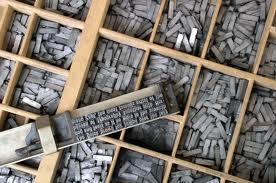
Our professor, Father Leland, (both Priest and scholar) was trying to impress upon us the near impossibility of accuracy in the transmission of text. To do so, he sent us to the basement of one of the oldest buildings on campus which housed an even older printing press. It was a behemoth, massive and intimidating, a mechanical beast that looked to me like it might cause some unfortunate mangling of limbs. There were large wooden trays divided into sections that were in turn full of sorts“sorts,” single iron letters. For the most part, they were organized alphabetically but it was clear a few letters had been thrown into the wrong boxes. Father Leland demonstrated how to insert the sorts into forms. Text for a printing press is assembled in mirror image, making the process even more prone to error. We saw precisely how the page was assembled, piece by piece, letter by letter. And incidentally, we learned the origin of the phrase, “mind your p’s and q’s,” which look identical when inserted backwards and are easily mixed up in the trays. Once printed, the mistake is noticeable, especially if the font has a serif.

It had been hard enough to achieve accuracy, said Father Leland, when monks were copying text for hours by candlelight in the Monastery and trying to decipher each other’s cursive writing. These scribes could misread a handwritten word, skip something by accident, or write something twice. The printing press was a revolution for all the obvious reasons, but also created new possibilities for error. It was easy to change the word “from” to “form,” “or” to “on,” or even “god” to “dog.” And how might those simple errors change meaning and interpretation? God to dog could be a particularly juicy slip.

To prove the point, we were told to reproduce a paragraph of text, any paragraph. The assignment would be finished when we had printed one correct copy.

I chose the last paragraph from one of my favourite novels at the time, F. Scott Fitzgerald’s The Great Gatsby. It took hours for me to set it properly. When it was finally correct, I felt so proud that I inked the press with gold and printed the paragraph on a bright yellow card stock. It was glorious to get it right, but what a process.

I wish I could find this yellow sheet of card stock now, the text vivid and practically glowing. If I could, I would frame it and send a thanks to Father Leland. But this story is the best I can do; Father Leland died in 2005 and, after thirty years, I have lost track of the physical object that resulted from his lesson.

We writers attempt this near impossible task of accurately transmitting our thoughts. We hope that mistakes have not been made, knowing they have. We hope that our meaning is clear, knowing that every reader will bring nuance we had not imagined to the text and the meaning will change. We write knowing so much is beyond our control. Try as we might, the p’s and q’s get mixed up. Now I have a computer, a spell checker, the internet. But mistakes are still made, just like they always have been.

It seems no coincidence that I chose the last paragraph of Gatsby for this assignment. In the immortal words of Fitzgerald, “So we beat on, boats against the current, borne back ceaselessly into the past.”