Category Archives: First Person

Tragically Hip: When you know what you’ve got before it’s gone

How can I keep a blog about writing I love without paying homage to The Tragically Hip and Gord Downie?

The Tragically Hip’s last tour, the news that Gord is dying of cancer, the last show—it’s all too much. My tears are real and close to the surface. And I’m not alone. Many of us have a special relationship with the band. It’s not often we know what we’ve got before it’s gone, and this is one of those times.

I went to Queen’s in Kingston (Arts ’85) when the band was hipgetting started. I had the same hair as Gord. I’ve never met any of them, but I’ve been in the same room. I remember an article about them in the Queen’s student paper. In the interview, they were treated like the Beatles. There was speculation about whether one of them was dead. It was smart, funny. I was hooked. I saved it for years but finally lost it in one of my many moves. I was at a show where they played the song “Bedrock,” from the Flintstones. Seriously. They used to do B-sides of Elvis. I’m not sure how many times I’ve seen them. I think I remember that Gord used to keep his back to the audience way back then. It was kind of great. I imagined him petrified, but doing it anyway, getting out there.

After I left Queen’s, I saw them in Toronto, an early show, at the Horseshoe maybe, or Lee’s Palace. I can’t remember. For a while, he lived in the apartment above a friend of mine. I’d visit and see “G. Downie” on the call button and wonder if I’d run into him on the stairs one day. I never did. I’ve seen them in stadiums in Calgary and Toronto. I took my daughter to see them in a hockey arena in Kelowna. No one stayed in their seats. Most of the audience jumped the boards and danced on the floor. When I hear the lines, “Watch the band through a bunch of dancers,” I am back there.

The last time I saw the Hip was in Boston. I’d been living there with my husband and the crowd at the House of Blues was full of Canadians. Every Canadian in a hundred mile radius was there, or at least that’s what it felt like. We wore our Canadian gear, our hockey shirts, our old Hip t-shirts. The House of Blues folks knew this was some kind of Mecca for us, although they didn’t quite get it. Their songs tethered me, tethered all of us, to home. They made me feel like myself again.

Some lyrics are more poignant now than ever. “You can’t be fond of living in the past,” or “Lower me slowly, sadly and properly, Get Ry Cooder to sing my eulogy.” I love that song. Every time I drive across the country and I leave the Shield and come over that rise on the TransCanada to the Prairie (you know the one) I stop the car on the side of the road, sit on the hood and blast it. In the old days, I’d have a smoke too. Not anymore. Those things cause cancer.

Other lyrics, even the name of the band, have new meanings since the news broke and these new meanings hit hard last night. Context is everything, right? Lines like “Nothing’s dead down here. It’s just a little tired,” and “Tired as fuck.” Yeah. I bet you are. It showed, of course, but it doesn’t matter. “I’m total pro. That’s what I’m here for,” he sang. And he is. “Every day I’m dumping the body,” was a gut punch for me.

One song that didn’t change in meaning for me was “Scared.” I used to listen to “Scared” over and over again when I had cancer. The “I” in the lyric was sometimes me, sometimes cancer. It became a constantly shifting confrontation. I used to go into chemo humming, “I’m not prepared. But if I have to.” Hearing Gord sing it last night was, for me, the emotional centre of the concert.

Thanks for the last memory Gord, the last concert, the epic effort you put into it. Thanks, to you and the whole band, for the last thirty years. I’m not prepared, but I guess I have to. I’m pretty sure you feel the same way.  So do we all.

On Downsizing Books

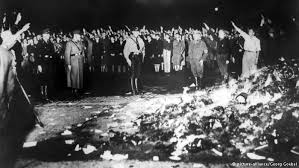
For much of my life, getting rid of a book was blasphemy. Books have always been sacred to me. As a young person, I was deeply affected by an image of books being burned by Nazis. Piles of books up in smoke. In my personal Ten downloadCommandments, One Must Not Destroy Books. We all know where that can lead.

There is a scene in the wonderfully cheesy disaster movie, The Day After Tomorrow, in which having taken shelter from a world-destroying storm in the New York Public Library, the characters begin to collect books they will burn to stay warm. One of the group objects and clings to a Gutenberg Bible, determined to save civday after tomorrowilization until another quips that there can be no harm in burning the multiple volumes of the tax code. The point is well made. Not all books have equal value.

Three years too late, I have come across this sensible and well-written piece about downsizing books by Summer Brennan called “On the Heartbreaking Difficulty of Getting Rid of Books.” It is based on Marie Kondo’s The Life-Changing Magic of Tidying Up. (Aside: I like to imagine Kondo’s books gathering dust on shelves everywhere, but that reveals something perverse in my nature.) What Brennan has done is apply Kondo’s now iconic zeal to her own life in a way that makes sense to her.

Brennan captures what’s wrong with any “one size fits all” approach to book culling. She writes, “It occurred to me that part of the reason why tackling the ‘books’ stage of the Full Kondo seems so daunting is that to many of us our books don’t really belong in the category she has assigned. They are not impersonal units of knowledge, interchangeable and replaceable, but rather receptacles for the moments of our lives, whose pages have sopped up morning hopes and late-night sorrows, carried in honeymoon suitcases or clutched to broken hearts.” Yes, that is it. The piece is well worth reading if you are about to embark on a book cull.  If you need further inspiration (and another book) go to the source material. Marie Kondo’s work has been much praised and mocked (a sure sign she is on to something) but I find there is something deeply consoling in her simple rule that one’s things should bring one joy.

Joy was the last thing on my mind when I moved from Calgary to Boston three years ago and faced the daunting task and considerable cost of moving fifty years of accumulated books. I cut my personal library in half. I never wanted to count how many books went. Too heartbreaking. I did it according to the space they took up. Each shelf was halved. I was methodical. For the most part, the Canadiana and hard to find books were boxed and went with me. Treasured gifts stayed. Books that brought me back to a specific time and place stayed. In short, books that had woven their way into the fabric of my life could not be given away. I worked hard to give my discards the possibility of a second life and keep them out of the landfill. If nothing else, I owed it to the trees.

Many of my Women’s Studies and feminist books went to two local women’s centres. That felt good. Except the ones I had to keep. Again, they were too much a part of me. I don’t even want to admit which books I ditched and which I kept for fear it will say too much about me. If I owned multiple books by one author, I would tell myself to keep only my very favourites. It was relatively easy to keep only two Dickens but then I kept every Carol Shields book. These were far too precious. I gave away Middlemarch, still unread since a Victorian Lit course in the 1980s.

Oh dear. I have revealed too much.

Of all the books I gave away three years (and two moves) ago, I have re-acquired only two. Oddly, one was Anne of Green Gables. Actually, I didn’t even have to buy it. A good friend, also moving, gave me one of her three copies. In the mean time, I have spared myself the cost of moving hundreds of books around (twice) and the cost of keeping a space to store them. Trust me, I still have a lot of books. For some reason, I feel it absolutely necessary to have six dictionaries.

Hard as it is to admit, you can have too much of a good thing. Even books.

Cancer is Not a Journey

Cancer is not a journey. Stop with the meaningless platitudes.

Cancer is a kidnapping. A hijacking. You’re going along, living your life and BAM. A bag gets thrown over your head and you are captured and you don’t know where the hell you are going. Or you are at gunpoint, being forced to drive by someone who won’t tell you the destination or how long it will take and you’re trying not to piss yourself. Or you have been thrown out on the side of a desolate highway with no water, no food and no map. You watch the car disappear in the distance. You might die of thirst. You might die.

A random bunch of rogue cells has taken over your body against your will disrupting everything you thought you knew about how your body works and who you are. Then it forces you to go places you don’t want to be. Like chemo. In the chemo room, you try to pretend it’s normal for fluorescent poisons to drip into your arm. You learn a language that you don’t want to learn and can only really speak among other people similarly kidnapped. It’s not like going to Spain and getting to try out a few phrases from the phrasebook you bought in the airport. There are no tapas. It’s not fun. You don’t get to feel more sophisticated and cosmopolitan because of it. Just tired. And terrified. You sit in a room with other tired and terrified people who have their own fluorescent poisons dripping into them and are desperately trying to learn this language and you smile instead of scream because it’s not their fault you are there, so what’s the point of screaming? Cancer doesn’t hear you scream. It doesn’t give a fuck. It’s a fucking sociopath. Sometimes it cuts off a breast just to make a point.

You’ve been kidnapped. Your sweat has a new smell. The smell of fear. Everything tastes like metal and who cares because you can’t keep it down anyway. You are grateful when you vomit and taste bile because it means your body actually might have absorbed some food before it rejected it. You hardly sleep and when you wake up, you wake up to the realization that you have cancer. Every damn morning. Several times a night. After every nap.

You try to think of a plan to get out. There must be a way. You’ll try anything. The hucksters and charlatans come calling offering you snake oil and herbs and magic pills and you will do anything, pay anything, to be freed from this captivity. You have learned the meaning of desperate. You cry. Often. Sometimes with other people. Sometimes alone.

Cancer hijacks your body and it hijacks your voice. There isn’t a person on earth who would want to go where cancer takes them. So stop trying to make it sound like it has purpose and meaning by giving it an archetype and calling it a journey and saying those in the middle of it are brave. It’s a fucking hijacking. People who have cancer are in the middle of trauma. They are scared. They are by turns angry and in denial and grieving.

Some people don’t make it out alive. The hijacker, all hopped up on their power trip, kills them, and there will never be any justice. That’s what cancer is.

Those who live do not come away unscathed from this calamity. Every single one of them has had to face their own death. It’s not pretty. It’s not a waterfall in Hawaii. No one takes a selfie. People who have cancer have to imagine the lives of their children without them. They have to come to grips with losing everything. Some have gone broke paying the ransom. Some have PTSD.

Calling this kidnapping, this hijacking, a journey is gaslighting. Stop it. Call it what it is. Appreciate the enormity of what people with cancer unwillingly face. Of what I’ve faced. I wasn’t on a fucking journey. I was clawing my way back to life from a cave I got thrown into against my will. I have friends in the cave now. Just do me a favour and stop calling what they are facing a journey.


Mothering, Feminist Consciousness Raising and Adrienne Rich

Many writers I love taught me my feminism. On International Women’s Day, I celebrate one writer in particular, Adrienne Rich, whose clarity of thought and forceful writing changed the course of my life.  Adrienne Rich
“Motherhood in Bondage” first appeared in the New York Times on the Op-Ed page on November 20, 1976. It is reprinted in many places, including a compilation of Rich’s prose called On Lies, Secrets, and Silence (Norton, 1979). By the time I read “Motherhood in Bondage,” (likely some time in 1993) I was already a mother and had already absorbed some feminist consciousness, despite my upbringing. I believed women must have the same rights as men. I knew that although some of the big issues like suffrage were settled, there were plenty of other important issues like pay equity that still needed to be sorted out. I had no reason to believe that this would not happen. Progress towards a more just society was inevitable, I thought. People marched, there were hearings or inquiries, problems were explained, legislation changed.

What I hadn’t thought about to any great degree were the systemic forces that kept oppression (not just women’s oppression but all oppression) going. I hadn’t thought about how those in power might create systems on purpose to benefit themselves and that changing the rules for women or people of colour or any powerless group might not be their priority. I had not thought about the effort that those in power put toward keeping a system that benefited them in place.

My pregnancy, the birth of my daughter and my new role of mother made me see how women remained oppressed in fundamental ways. My daughter was born in 1992. I had to fight to receive my full maternity benefits, something that the law said I was entitled to but my employer was ready to deny me. The threat of legal intervention was needed to resolve the dispute. Preparing for the birth, I had wanted a midwife but was told that if I had one, I would have no access to my doctor or a hospital in case of emergency. I don’t even know if this was true or simply a threat, but I acquiesced. I had never felt so patronized or controlled. At about twenty two weeks, strong contractions and bleeding sent me to the hospital and I was told it was nothing and sent home. I was made to feel like I had wasted everyone’s time, but if I had stayed home and anything had happened, I would have been blamed for that too. During my daughter’s birth, I was scolded. It was taking too long. The doctors, the same ones that were so essential to this process, did not intervene when they should have, caused me unnecessary suffering and then blamed me for it. After the birth, when my daughter didn’t immediately latch on, I was told that my insistence on breastfeeding was jeopardizing her life. They insisted on formula. I would not let them give her any. Her lethargy was blamed on me because I had, in the long hours of unproductive labour, taken a pain killer and this had made her groggy. It was my fault she would not latch, they said. The nurse left my chart out. I read it. It said I was non-compliant. I left the hospital. At home, I struggled to understand what had happened to my life. My once reasonably equitable marriage had become something else; my husband went to work and I breastfed, looked after our baby, our house, our meals, our errands and did all the unpaid labour. This seemed fair. I was home. Why wouldn’t I do all of these things? The logic seemed unassailable, but somehow, I knew it was flawed.

Meanwhile, my husband had become a father and he was still encouraged to pursue other goals. I was not. Although I knew that my “work,” had value in the broader scheme of things, I had no place in that scheme anymore. I was encouraged to join a mother’s group. I did. It depressed me. I did not go back. For the first time since I was thirteen years old, I did not earn money. I was utterly dependent and I felt ashamed. I looked into returning to work, daycare, pumping breast milk, all of it. Much as I wanted to be back in the bigger world, I wasn’t ready to let go of the baby to do it. I made a choice. (And before you stomp all over me, I recognize many women have no such choice. I recognize my privilege. But this is, after all, a personal essay. This is how it was for me. I’m not claiming that this is how it is for everyone.) Being forced to make the choice felt like cruel but all-too-usual punishment. But punishment for what? For being a mother? My husband was never judged for his choices, but I would be judged for mine. All the while, I felt that the choice I was being asked to make was somehow false. I felt there had to be another way.

I began looking for kindred spirits, teachers, someone who could explain what had happened to me, what was happening to women who became mothers, and I found Rich.

The understanding that male-female relationships have been founded on the status of the female as the property of the male, or of male-dominated institutions, continues to be difficult for both women and men. It is painful to acknowledge that our identity has been dictated and diminished by others, or that we have let our identity depend on the diminishment and exploitation of other humans. This idea still meets with resistance that has always risen when unsanctioned, long-stifled realities begin to stir and assert themselves.

Painful to acknowledge indeed. And not just for me. For my husband too. It was not his intention to oppress me, and I knew that. But by default, he belonged to a political and social context that oppressed me. Rich explained that my sudden dependence and vulnerability did not happen because of a particular failing of mine or a particular meanness within my husband. This was vital to remember. And she also explained that figuring out a better way to relate to one another and the world was essential and was going to be difficult. But no matter what our social and political context, we always have agency. We always have free will. I had to do everything I could do to improve the situation.

“The power politics of the relations between the sexes, long unexplored, is still a charged issue,” wrote Rich. “To raise it is to cut to the core of power relations throughout society, to break down irreparably the screens of mystification between ‘private life’ and ‘public affairs.'” Indeed. Motherhood as an experience, as a political institution, had been defined by men. Women played by their rules. Men created legislation around birth control and abortion. In a fundamental way, women were (and still are) unable to decide for themselves if they wish to become mothers. At the time, men still wholly controlled the guardianship of children in the courts, the educational system and within the family. Men dominated women economically, an inevitability in a capitalist system that valued men’s work more than women’s even when they did the same work. Again, this is still true. And finally Rich explained how the women who challenge this system, who question it, who try to break free of it, were seen as deviant. And we all know what happens to deviants.

Rich wrote, “the pressure on all women to assent to the ‘mothering’ role is intense.” This is what I was feeling; the pressure to be a mother in a way that had been prescribed by someone else, in a way that allowed me to survive but not thrive.

I could have given in. I could have swallowed hard and gone along to get along, put up and shut up. I didn’t. In the conclusion of the essay, Rich had given me my marching orders, although I wouldn’t understand for many years that I had accepted the challenge she offered. She wrote:

Such themes anger and terrify precisely because they touch us at the quick of human existence. But to flee them, or trivialize them, to leave the emotions they arouse in us unexamined, is to flee both ourselves and the dawning hope that women and men may one day experience forms of love and parenthood, identity and community that will not be drenched in lies, secrets, and silence.

I wanted to find this better future for myself, for my baby, and for my husband. I examined my life. I learned more. I studied. I worked in the community. I observed. I listened. I taught Women’s Studies. I tried to help others understand these issues and more. And although it was never easy, it got better. I had a goal in mind, a vision of equity, if not equality, a sense of fairness. On this International Women’s Day, I thank Adrienne Rich for giving me direction. I hope that every woman can break free of her own lies, secrets and silence. I’m still working on it. It’s a life-long quest.


Political Writing, George Orwell and the Republicans

An American writer recently advised me not to write politically. I thought, “Surely, I have misheard.” (Truth be told, I actually thought “WTF,” but I’m granting myself a better vocabulary in the retelling). The context was a conversation about the upcoming American election. I had asked what role he thought writers had in the mess. None, he said. Political writing makes for bad art, he said. I countered with Orwell. He said “British,” and thus dismissed my point. I visualized George Orwell rolling over in his grave but I think Orwell would dislike the image. He would probably call it overused, which it is. It is also unclear. It is meant to imply anger and restlessness but could just as easily imply resignation. Roll over, pull the shroud up over your shoulder and ignore it. So instead, I’ll visualize Orwell pushing against the lid of his coffin, desperate to get a word in on this argument. I countered again with Steinbeck. The American writer said, “A different time.” He warned me I could have no commercial success writing politically. As I was about to list a host of contemporary American fiction writers whose work is both political and successful, the real issue came out. He had written something political on social media and lost friends. Sometimes, we are simply afraid.

Writing I love is always political. It has a high likelihood of offending someone. If George Orwell were alive today, I suspect that he would have something to say about the current nominees, both Republican and Democrat. He might write an essay. He might write a work of fiction which touches on the problems of the present. I doubt he would have held back.

IMG_2843

Orwell would have braved the haters and the internet trolls and the columnists from Nowheresville who resort to ad hominem attacks and straw man arguments. It would have been a thing to behold. We need Orwell now. But Orwell is dead. The best we can do is strive to be like him.

In Orwell’s essay “Politics and the English Language,” he writes, “In our age there is no such thing as ‘keeping out of politics.’ All issues are political issues” and I couldn’t agree more. Most people know this particular essay as the source of excellent writerly advice like using clear language and avoiding spent metaphors. He laments that “our thoughts are foolish, but the slovenliness of our language makes it easier for us to have foolish thoughts.” Lazy and inaccurate language begets lazy and inaccurate thinking and in turn, lazy and inaccurate thinking begets lazy and inaccurate language. We must break this cycle, and Orwell suggests paying attention to language is a good place to start.

Orwell would demand a specific example. Here is one. Mr. Kasich, a Republican, is described as “moderate.” Moderate is a political label that has become meaningless, just as Orwell notes the word “democracy” has become meaningless. Its use here is inaccurate and lazy. Moderate compared to what? Please, define your terms. The word moderate is being used to imply Kasich is “good” or that, less optimistically, he is the “best of a bad lot” or, perhaps, “not quite as crazy as the others.” But recall the reciprocal nature of the relationship between language and ideas. If, as a result of numerous namings of Kasich as a moderate, Americans visualize him when the word is used, we will have succeeded in further confusing the meaning of moderate. To reverse the process, he must be called what he really is.

But why single out Mr. Kasich? Many have argued that, in fact, the Republican candidates are all saying much the same thing. They each espouse racist and xenophobic ideas. Mr. Trump is not an outlier, not within the candidates, the Republican party, or possibly even the American people. Sure, some of the candidates, like Mr. Trump, appeal more to the KKK than others. But that doesn’t mean that the others do not appeal to the KKK. Ironically, in between the bluster and incomprehensible phrases of jingoistic nonsense he has pushed together to create his campaign, he has done something that Orwell would advise. On select ideas, he has removed the mask of codified language, pretentious diction, and economic and legalistic jargon that has long obfuscated the hobbesian brutality of Republican goals. (Orwell would hate that sentence. How about this: Regarding race and immigration, he has been explicit and revealed the brutal end game of Republican policy.) As a result, his audience has found him and responded accordingly and he is winning. Unfortunately, the language he uses still comes from failed thinking. 

It was 1946 when Orwell wrote “the present political chaos is connected with the decay of language,” and this statement is equally true in 2016, seventy years later. His essay teaches all writers how to avoid spouting the meaningless drivel that inundates us in every news cycle. And it is well past time that we as writers use his suggestions. We must explain how these candidates defy the American Constitution and demean the American dream. Or rather, YOU must, American writers. It’s your country. Do so clearly, explicitly, using clear language and specific examples. Orwell promises that if you write in this style your thoughts will become clearer and “when you make a stupid remark its stupidity will be obvious, even to yourself.”

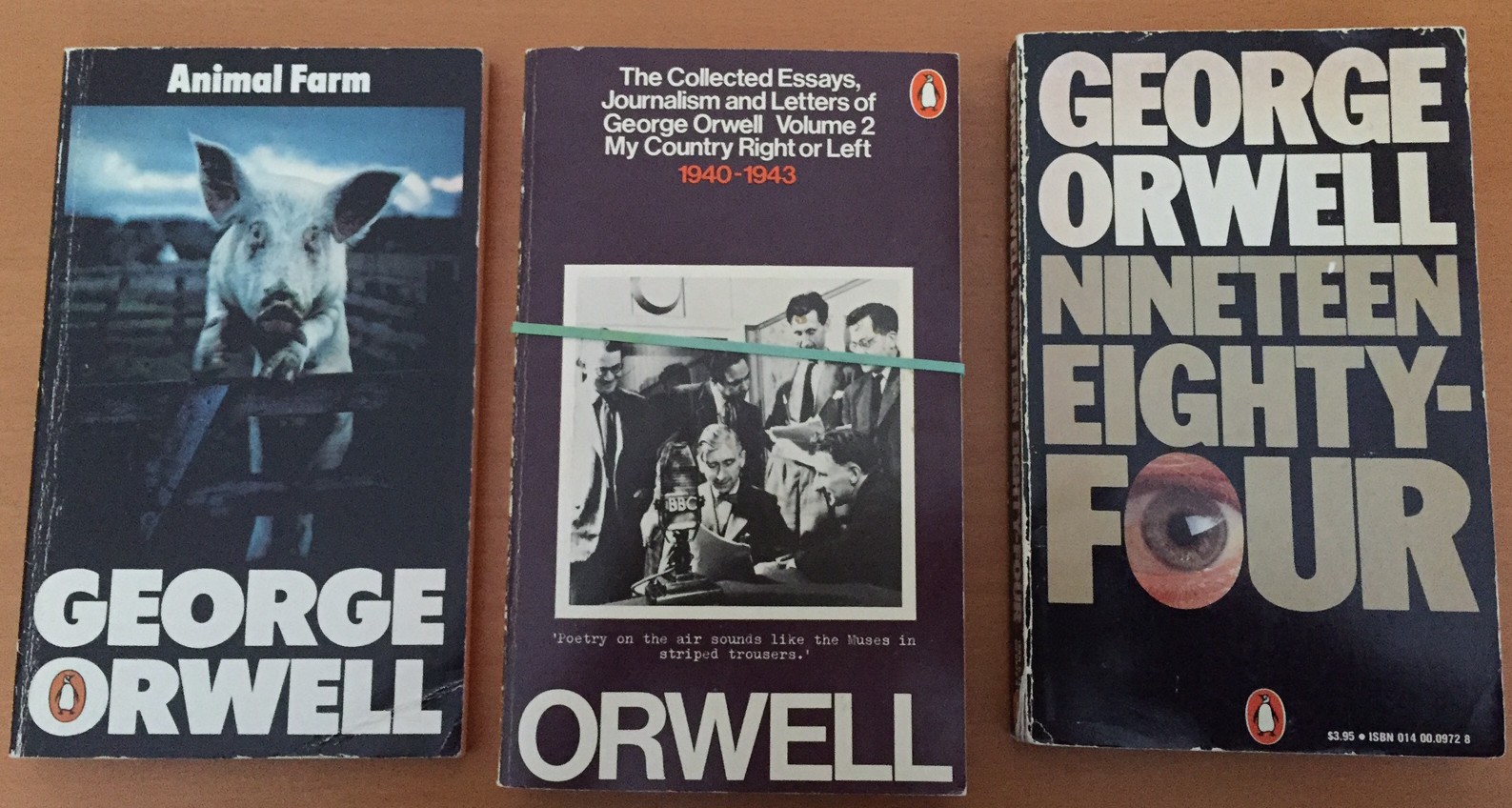
I revisit Orwell’s writing often, particularly The Collected Essays, Journalism and Letters of George Orwell. I happen to have Volume 2, conveniently subtitled My Country Right or Left, 1940-1943. It is old and held together with an elastic. My copy originally belonged to my older brother. It was one of his high school texts, and somehow, I have come to have it. The passages that he checked off in the index include “Review of Mein Kampf by Adolf HItler,” “Review of The Totalitarian Enemy by Franz Borkenau,” “Prophecies of Fascism,” “Literature and Totalitarianism,” and “Who are the War Criminals?” among others. I expect these were the ones he was assigned to study. My brother went to a Catholic school and was taught by Jesuits. It delights me to know that this work was part of their curriculum. I mention it because there is a whole other essay here on the importance of good teaching and public education, but I’ll save that for another time.

I find something arresting every time I go back into this book. Today, in “Prophesies of Fascism,” I stopped short on these lines in which Orwell, referring to writer Jack London, makes the point that London did not fall into the trap of fascists, that he “knew that economic laws do not operate in the same way as the law of gravity,” but that they can be “held up for long periods by people who, like Hitler, believe in their own destiny.” And people like Trump.

It’s time to be clear, precise and unafraid. We need to call a spade a spade. But because Orwell would hate the phrase, I will revise again. We need to call out candidates as fascist when they are fascists, as facile when they are facile and fraudulent when they are fraudulent. Language is called Orwellian when it is propagandist and obstructionist. But as writers, let us rethink the meaning of Orwellian. Let’s write as Orwell would have. Let us be Orwellian.