Category Archives: About Writing

Concussions and Confined Settings

I’m reading concussion stories, and my colleague Elaine Morin pointed out Lauren Groff’s excellent story in the New Yorker, The Midnight Zone. It’s full of truth and suspense and fractured thoughts and a fractured head and it took me, inevitably, to the reading of an interview with Groff, which was (sadly, for my purposes) more about motherhood than concussions, although both topics are writerly obsessions of mine, the former being a thirty-year obsession and the latter much newer.

(I read that last sentence three times, by the way, and it is technically grammatically correct. It is representative of the tangential way my mind works these days, and I’m keeping it as is. Welcome to the inside of my head.)

In the interview, Groff makes a great point about setting. The setting of the story is confined to a small cabin. Danger lurks outside, but also liberation. Asked about this, she says, “it’s psychologically easier to live if you believe you have an exit plan. It’s easier to run ten miles if you tell yourself that you can walk when you get to eight; it’s easier to work for four hours without a break if you keep the door to your office open; it’s easier to live with how we’re killing the planet if you believe the completely insane notion that humans will colonize Mars.”

She’s so right. And I love the way she extends the situation of the story to the much larger world. But back to concussions. Three years (plus) into this brain injury, I am still keeping the door open. It’s easier to live that way. It’s behind me, back there somewhere, even as I stare down the very real possibility that this is as good as it gets for me. Concussion and confinement go together. Concussed people avoid light and sound and people and life. I wonder if Groff made that connection? Do you ever wish you could talk to a writer and ask these questions, go deeper into something you find fascinating in their work?

Suffice it to say, I am now a Groff fan. Maybe one day I will get to talk to her about how she knows so much about brain injuries. Until then, I’ll keep reading concussion stories.
This writing prompt is for the birds

The last few weeks of winter have been hard. The snow piles that became ice piles finally begin to melt. A relief. But with the melt comes the revelation of how much garbage is on the ground. So many coffee lids, cigarette butts, fast food wrappers, bits of blue plastic twine, (why is there so much blue plastic twine and where does it come from?) a rubber glove, a ruined pink toque now dark with grime.

The birds are back, and that is something. They fly in and out of the Bulk Barn sign, nesting in the curve of the “u” and the “a”. Then I see a sparrow flit to the sidewalk, pick up some blue plastic twine and take it to the nest.

This bird is making its nest with garbage.

Is this awful or not? I can’t decide, but the image sticks. It is a metaphor for everything. I can make it optimistic or pessimistic or both simultaneously.

Use it. Write.


Snow Day!

Is there anything better than a snow day? Is there any better story prompt than SNOW DAY! I don’t think so.

Go outside. Stand in the cold. Kick your feet through the snow. Is it powdery? Sticky? Does it squeak underfoot? Let the cold get to you. Let your nose turn red and start to run. Remember sledding, that time you just missed that tree, or that time you fell off and the sled went into the river and you stopped just short, scrabbling at the snow going by with frozen hands inside of gloves so big they might as well have been oven mitts. How does it feel? Remember the feel of snow in the gap between your pants, socks and boots, how snow could build up in there and give you a rash on the back of your legs. What is happening to your fingertips? Is snow getting inside your collar? Shovel a bit. How heavy is the snow?

What are the animals doing? Where do the squirrels go when it snows? Where are the birds? How does it sound out there? Is snow falling from tree branches? Has it piled up high on the fences? Is it blowing from roofs? Is it drifting? Are there other people around? Describe how they are bundled up. Can you see their eyes? Are they squinting against the snow and wind? What are they thinking?

When you get inside again, read that Jack London classic, “To Build a Fire.” Not many people will ever experience something like that. But plenty among us are homeless, struggling to survive in the city, sheltering wherever possible, trying to stay alive. What’s the conflict in a story like that? Human against nature, certainly. But isn’t it also human against capitalism? Neoliberalism? Pull-yrself-up-by-yr-bootstrapism? Recently in Toronto, a woman died because she was trapped in a clothing donation bin. She was looking for dry clothes.

Or, stay sheltered with pen and paper in hand. What do you see from your vantage point? How does the warmth feel? Do you feel gratitude to have your shelter? Are you annoyed that your are stuck and that the roads are too bad to drive on and the buses are trapped on icy hills? If you stay home from work, do you lose a day of pay? Is there somewhere else you need to be? Are you anxious? Is it terrible to feel the loss of control?

Or does it fill you with joy and wonder? Snow. Snow day!

Think about all of it. Think about whatever this makes you think about. And write.


Submissions Continued: It’s a process

It’s public accountability time. I said I would get 10 submissions done by January 15 and I’ve done three. I forgot. It’s a process. A time-consuming, angsty process.

I know I have one day left, but tomorrow is not a day I’m going to get any submissions done, so I admit defeat.

BUT–here is what I did accomplish. I created a plan for myself. I researched every possible Canadian publisher who is accepting unsolicited submissions and found all their requirements and figured out where my book fits. This meant studying back lists. It’s a process. The Writers’ Union of Canada has a helpful directory, (cost 10$), but beware: it is already out of date. Everything needs to be cross checked with the publisher websites and some publishers who were accepting unsolicited submissions have stopped. (Hello Anvil Press). Then I tiered my submissions from first choice to last. And so, a submissions strategy was born.

Next, I created my “Master Query Document,” which includes everything I might use in any query, from my bio to a marketing plan, (this means that I also created or spiffed up all of these things, including a marketing plan). I finally have a synopsis that actually works. It goes without saying that I already have a book, but maybe it does not go without saying, so I will say it.

I have a lot of *feelings* about being asked to create a marketing plan. I get it, but honestly, anyone who can guess what is happening in publishing must have a crystal ball at this point. I think what publishers really want to know is: will I work hard to sell this book? The answer is yes.

And then there were other very practical matters. I figured out what happened to my long dormant Submittable Account, went to the office supply store and got paper and envelopes. Some publishers still want a hard copy, and I have to say, I appreciate that. I think a physical stack of paper is somehow more insistent and harder to ignore.

And I have sent in my first three submissions, one via email, one hard copy and one via Submittable. Yay me.

I’ll finish the next seven by the end of this week. I’ll be two days over the deadline, but what’s two days in the lifespan of creating this novel? Barely a dot of an i at this point. And it’s not like anyone is waiting to see it. And isn’t this the crux of the problem? Who cares about this besides me? Maybe you. Thanks for reading, and for giving me a sense of a deadline, even if I did make it myself, and even if I did blow it.


Submissions

It’s been so long since I have posted on my site that I forgot how to get into it. Obviously, I solved that problem. Now for the rest.

Recovering from my concussion has been a long, terrible process that I don’t want to talk about. Now, I have to reclaim my life as a writer. Will I be able to? I’m not sure.

You may recall that when my regular programming was interrupted, I was part way through a novel. More than part way. Almost finished. That was April 2016, a very long time ago now. I’ve tried to keep at it. What would have been done in about two months prior to my concussion has taken me two years instead. And honestly, there is something in the voice that is altered. I can’t put my finger on it. If I could, I would fix it. As a very wise writer I know advised, I have done the best job I can do as the writer I am today.

I came to the point where I needed feedback. I invited readers into the world I have lived in, mostly alone, for ten years. Oh, what a relief! Finally, I could talk about my characters with other people, real people. It was like I was introducing my friends to a secret group of friends from another part of my life. My worlds collided and it was glorious. And the things they said about my characters! It was a delight to get all of this reaction, to know that my intention was carried through my words. Lovely news for any writer. To everyone who did me the honour of reading my book, I thank you.

I know the fundamentals of the book are solid. I have had lots of encouragement. I was told again and again it is ready to submit.

The word “submission” is not one I like to have to close to me. To submit is to put my fate entirely in the hands of another. Or is it? It is to put my book in the hands of another. It is not me. My success is sealed. In spite of everything, I finished. I feel good about that. I will always feel good about that.

I started submitting to agents, not because I think I’m so fancy that I need an agent, but because my concentration is still pretty limited and I would love for someone else to do the business end of this work and to keep track of the things that are still awfully hard for me to track. But it seems it is not to be. I will have to do this myself, like most writers do, at least most of the writers I know. But you can’t blame a gal for trying. Nevertheless, thanks to all the agents who have read it, especially those who offered feedback and encouragement. Who knows? One might still get back to me with a positive response.

But I am moving on to publishers now. I will use this space as a place where I describe this terrifying process, so replete with rejection and self-doubt. Follow along, if you like. The working title of my novel is “Patterson House,” a perfectly respectable title, although honestly, I always wanted to call it “Constance,” after one of the two main characters. I still might.

As a form of public accountability, I vow to have this MS sent to ten publishers by January 15. That’s an awfully generous time-frame, you might say, but it’s the holiday season and whatnot. I don’t want to over-promise. I’ll let you know how it goes.


Anne Fadiman and Confessions of a Common Reader

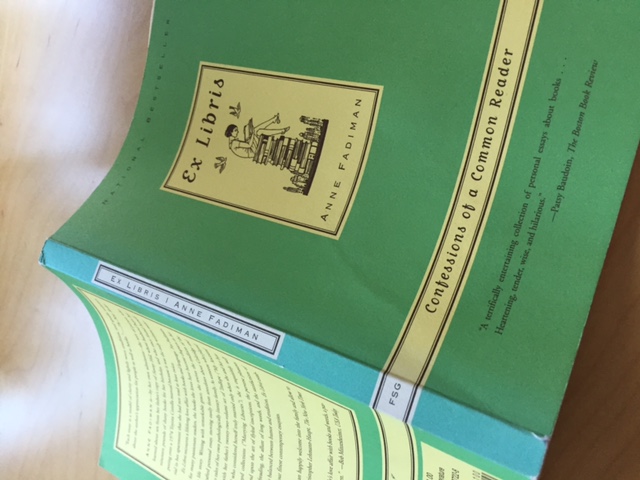
As part of my ongoing concussion recovery, I’m teaching myself to read again, an activity that I always found so joyful before and now find so daunting. I am generally re-reading. It’s easier, what with my memory the way it is now. Anyway, the trivialities of my self-initiated treatment plan aside, what better book to re-read than Anne Fadiman’s Ex Libris; Confessions of a Common Reader.  ex libris

In it are eighteen delightful essays about reading, about books, about personal libraries and about words by someone who is, I would say, an entirely un-common reader. Fadiman is the kind of person you see walking on the street devouring a book open in front of her. Her taste for reading was nurtured by her academic parents in a household stuffed to bursting with books. Her own writing is scholarly without being snobbish, a situation ripe for incidental learning. The book is full of factual tidbits so seamlessly incorporated into its text that I come away feeling as though I could hold my own at an English Department dinner party. The tone is friendly and confiding. Her vocabulary is vast and slants Victorian, which, to my mind, is an asset.

My copy of Fadiman’s book is slightly ruined in my own library – a little warped from moisture, a little dog-eared, and not without considerable underlining and marginalia. Her essay, “Never Do That to a Book” issues a solid approval of all of my mishandling of her work. She writes of her childhood in which she used her father’s books as building blocks and how her own children do the same with hers. She writes of people who eat books, literally digesting the words, and her own son’s consumption of the corners of Good Night Moon. It occurs to me that for Fadiman, the rating system for used books employed by on-line purveyors is entirely backwards. A five-star book condition for her would mean a book was stuffed with notations and worn pages and a “like new” book would not interest her at all. Her essay about inscriptions in books has left me changed forever. Never again will I just dash one off.

It is difficult to choose an essay to highlight. I love them all. Like all the best personal essays, each one touches the universal. We are not just reading about reading; we are reading about life and death, marriage and parenting, love and loss. Her description of the process that she and her equally bookish husband undertook to marry their libraries  describes both a marriage and a library for the ages. In a later essay, she explains how, after inheriting part of her father’s library, she kept it in separate book shelves at first and then changed her mind. Integrating his library into hers becomes a testament to how the people we love and lose become indistinguishable parts of our own lives. It is deeply reassuring.

If I had to choose a favourite, “Nothing New Under the Sun” might make the cut. It is a sly investigation into plagiarism that should be read by every teacher and every writer everywhere. The footnotes are screamingly funny. I would love to plagiarize it, but I won’t.

I remember exactly how I came to be in possession of this book. It was a gift from a dear friend, Arlette Zinck, a kindred spirit in reading, and I hope I thanked her appropriately at the time. If not, I do so again.

Lastly, as if these essays weren’t enough, Fadiman’s final pages include recommended reading (of course) – a bibliography of other books about books. It is marvelous.

Give yourself a treat and buy a copy, preferably from a dust-mote filled used bookstore, and curl up under a blanket. Lay it down, open and upside down, on your bedside table, pages splayed and dog-eared.

Fadiman, Anne. Ex Libris. New York: Farrar, Straus and Giroux, 1998.