Category Archives: The Grim Reader

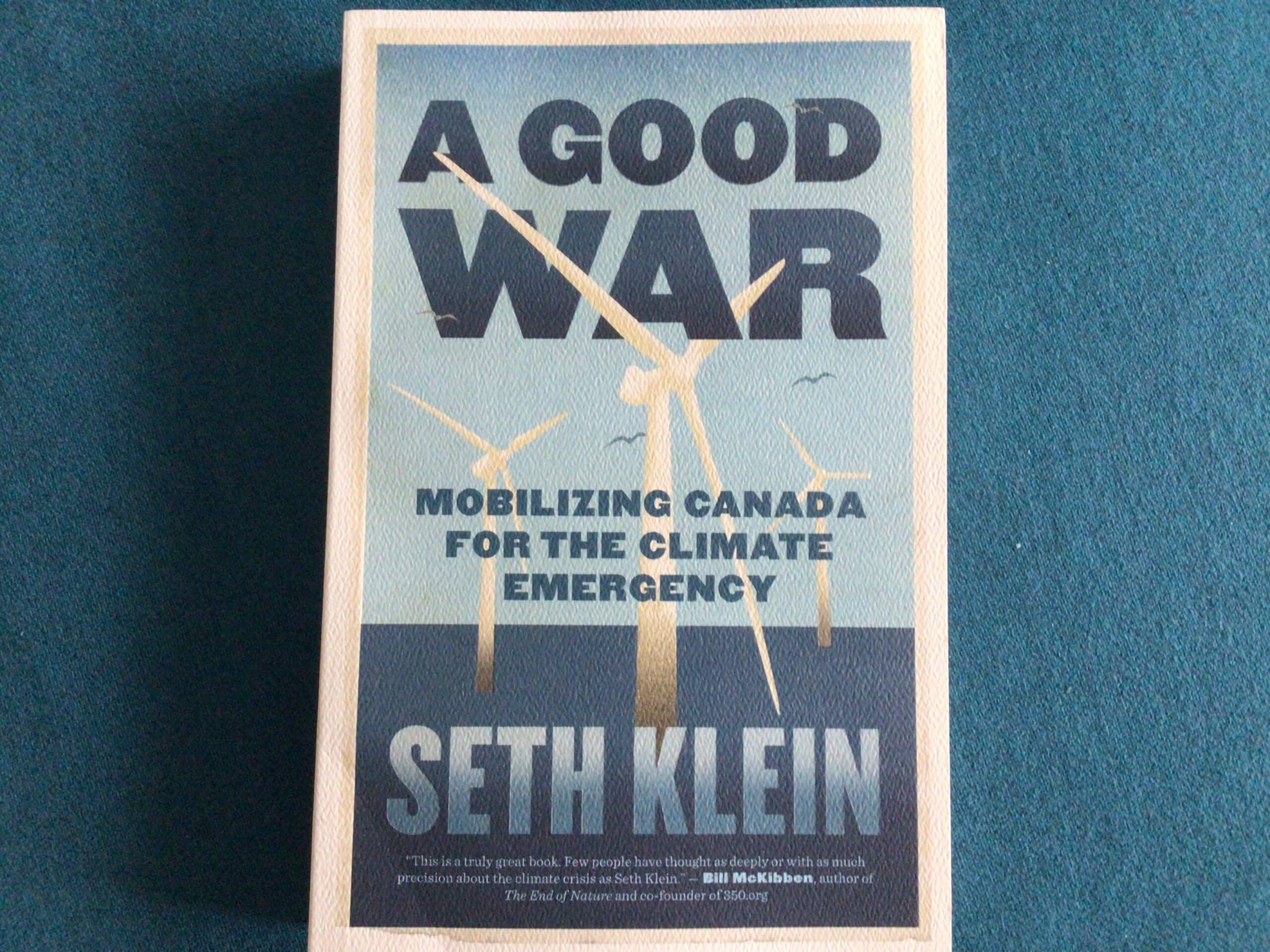
The Grim Reader: A Good War by Seth Klein

The Grim Reader (that’s me) continues with Seth Klein’s A Good War: Mobilizing Canada for the Climate Emergency. TBH, I was not expecting to like this book. I thought the metaphor was tortured, that the very idea that we could harken back to WWII and say, “Hey! Canada did it before so we can do it again!” was too much to bear. Maybe even jingoistic. I don’t ever want to look to war as an exemplary time. But I get it now. Sometimes you have to read the books you are disinclined to read. Klein has a point.

And I have to hand it to Klein for taking the most grim situation ever (climate catastrophe) and placing it against the mirror of World War II to give us exponential grimness. But it makes sense. It’s probably good to remind us all of the dangers of fascism and authoritarianism. Everything old really is new again. Klein reminded me of when we used to fight fascism. Those were the days!

I became engaged with Klein’s argument when he made the point that we are in an emergency, and we are failing to act like it. It’s like no one in charge wants us to know. But it’s time to spell it out. And lucky for us, Klein shows us that there is a play-book to follow. Another seemingly ineffectual government was similarly challenged and pulled itself together. It can be done.

Klein is not merely giving a history lesson, although he is giving a history lesson. He always comes back to the present with specific examples of how we could use the same idea now. It’s refreshing to read something so practical.

One of the many things I learned from Klein is that during the war, the Canadian government established Crown Corporations to do whatever needed to be done. I think they made 37 of them, but don’t quote me. I’m bad at remembering numbers. Let’s just say there were many. And these Crown Corporations got Canada ready for war. Now we have to gear up again. And sure, we should have done it thirty years ago, but here we are. Better late than never.

And not to get stuck on the Crown Corporation idea (there are many more in this book), Klein has a list of possible Crown Corporations that the Federal government could create now—RIGHT NOW—to manage us off fossil fuels. It’s a good list. I wanted to cut and paste it and send a letter to the Prime Minister.

The part that seems impossible to me is getting ideas like this through a polarized government where partisanship has taken the place of leadership. In times like this, can we get unifying messages out to create the kind of “All for one and one for all” can-do attitude that emerged during WWII? The obvious opportunity is to use the CBC. The CBC should be talking to Canadians about climate every day from Sea to Sea to Sea. Instead, our national broadcaster is facing even more cutbacks, and does anyone even care anymore? The public institutions that could be our helpers in this time have been made ineffectual and even dysfunctional. It feels purposeful. It saddens me.

(And yes, we are talking about a need for propaganda, by any other name. Messages of unity in the war were certainly propaganda. But if it works….)

There are ideas in A Good War that can help us in our quagmire. Nothing can help us out of it. It’s too late for that. But these ideas could ease the transition we are going to have to make whether or not we want to. They could make it less bad. And in the spirit of the book featured in the last Grim Reader, I Want A Better Catastrophe, being “less bad” is important.

Lastly, I think A Good War is a book that will speak to an older generation that many have almost given up on in terms of who might pitch in with our climate emergency. Too often, seniors are understood as the cause of the catastrophe and not part of the solution. There are a lot of seniors with energy, ambition, and time on their hands. Not to mention children and grandchildren that they love. Maybe Klein is on to something.
The Grim Reader—Climate Change Books

I’ve been reading about climate change. I’ve been reading so much about climate change I’m starting to call myself The Grim Reader. And of course, no one wants to talk about it. Or they do, but they don’t know how. So I’m starting a new thing. A book club for one. The Grim Reader. Come along with me. Comment. Maybe it will not be a book club for one after all.

Like most people, I’d like to leave behind a world that is recognizable for those who come after me. I have an adult daughter. I’d like her to live in some degree of security and comfort after I’m gone. And if she has children, I’d like their world to be safe, secure, and somewhat recognizable. And if that’s what I want, it’s time to get serious. If we keep going the way we are going, those simple wishes will not come true. Not for me, not for any of us. We hit the 2 degree mark last week—twice. That is, we were 2 degrees over our pre-industrial average. It’s what “they” have been telling us for years absolutely can’t happen. And it happened.

Meanwhile COP28 is being held this week in a petro-authoritarian state and was being called a failure before it even started. *Sigh*. I expect there to be a lot of sighing in The Grim Reader. But there is hope.

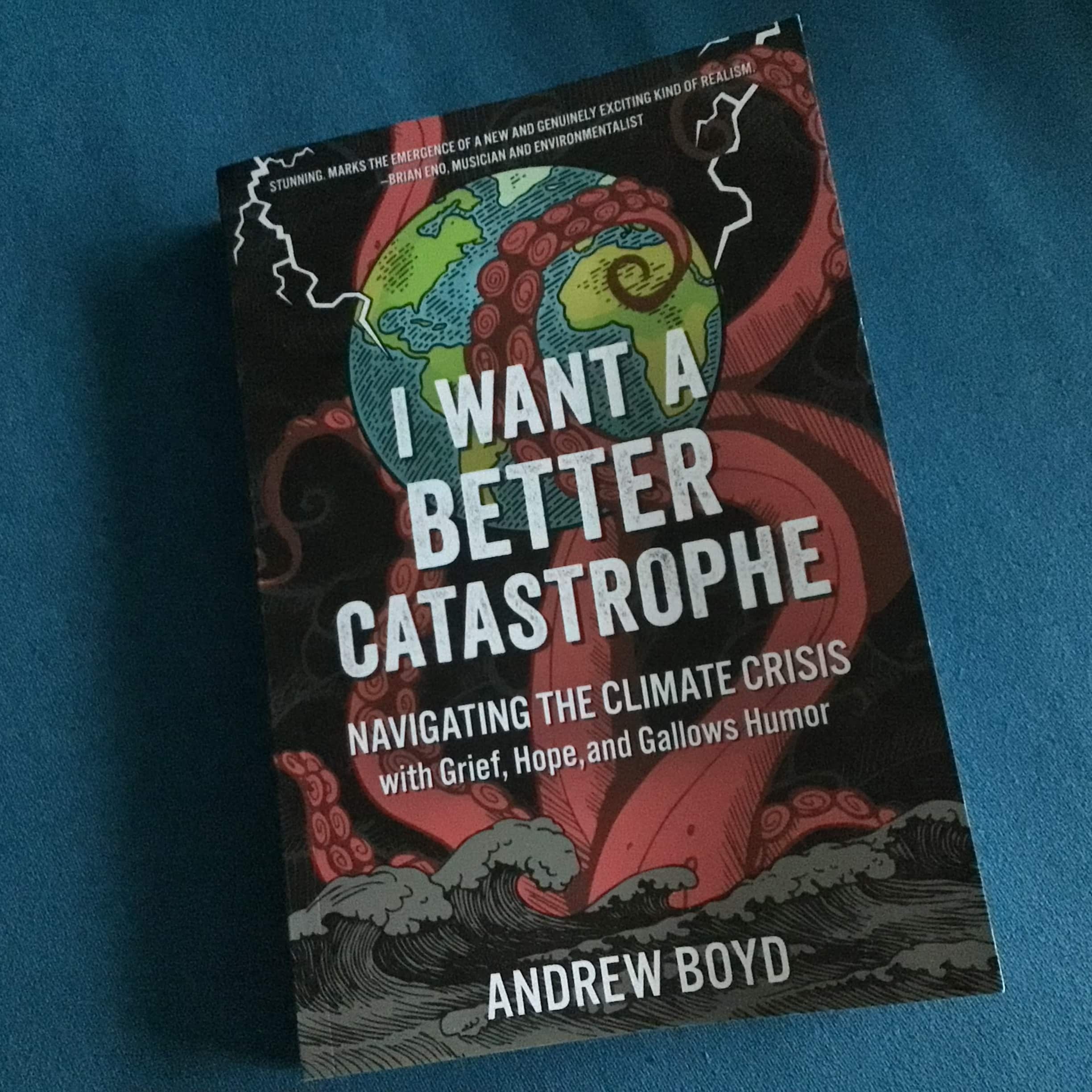
There are a spate of books about hope and climate change. All the behavioural psych research says we have to have hope. Why act if there is no hope? I am personally of a more existential bent. I believe we can face hard truths (for example, each and every one of us is going to die) and still find meaning, joy, and purpose in our lives. This is why I want to start The Grim Reader with Andrew Boyd’s, I Want A Better Catastrophe.

Boyd isn’t sugar coating anything. The premise of IWABC is that climate catastrophe is here. It’s baked in now. We’re in it. Welcome to the future. In his words, “We’re fucked.” But stay with me. He wonders, if we’re fucked (which we are), are we totally fucked or mostly fucked or a just little bit fucked. It matters. Because we want to find a better catastrophe.

A better catastrophe is still possible, although the window is closing by the second. There is hope here. But it’s realistic hope. It’s the kind of hope that doesn’t exist purely as a result of denial. It’s the kind of hope I can get behind. It’s a “roll up your sleeves” kind of hope.

In describing his own journey as an activist, Boyd talks to so many others about theirs. There is dark humour, which is something I really need. Maybe that is what inspired me to call this new part of my website The Grim Reader. 

IWABC is almost a compendium of everything everyone has ever said or thought about global warming/climate change/climate catastrophe. You can read it straight through or pick out pieces here and there.

There is even a little section on the right thing to call global warming/climate change/climate catastrophe. My own preference is climate catastrophe, but I think it turns people off. Too doomy. I’m currently throwing the term “climate insecurity” against the wall to see if it sticks. Because isn’t security what we all want? (Tangent Alert: If you think about security too, you might also want to listen to this year’s Massey Lectures by Astra Taylor.)

I also appreciate that after 352 pages, Boyd offers even more resources to turn to under the title “Stuff You Can (Still) Do.” It’s inspirational. You can reach the same information through his exceptional website, BetterCatastrophe.com.

If you do nothing else, check out his incredible flow chart. It’s a thing of beauty and a wonder of communication. It may change you. It changed me.

If you’ve read it, if you want to read it, if you have questions, please comment. I’d like not to be in The Grim Reader bookclub by myself.

(I review the occasional book on Goodreads, and IWABC is one of them. Some repetition, but also some other thoughts.)